

Before You Hire a UX Researcher, Test One Flow
Early teams can learn a surprising amount by testing one critical flow before building a large research process or hiring a dedicated researcher.
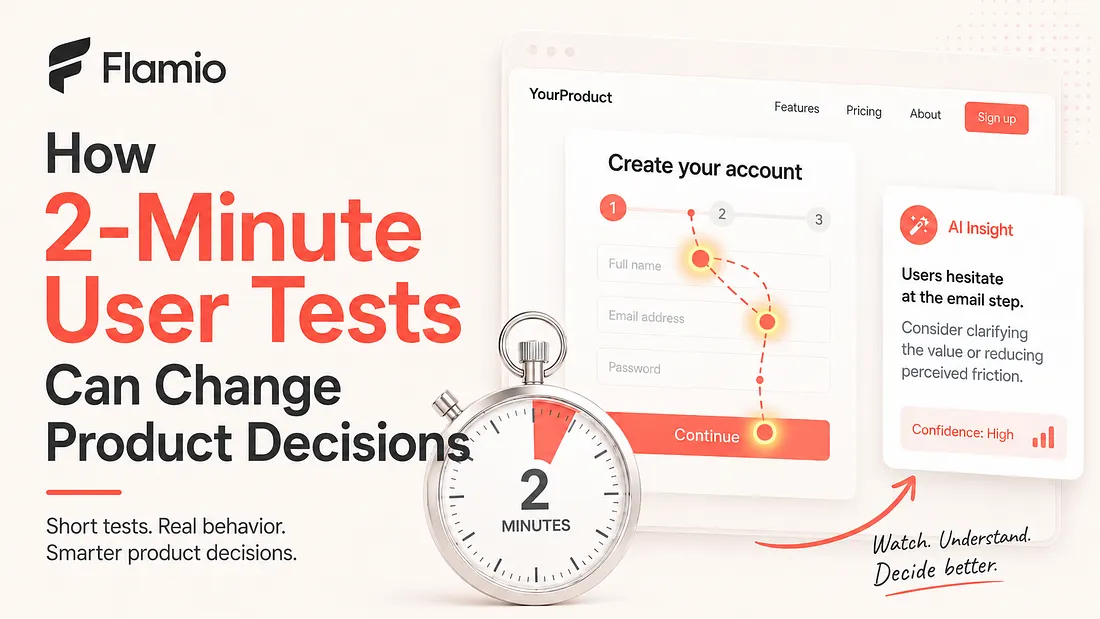
Early-stage founders often treat UX research as something the company will do later. After the next release. After the redesign. After the team hires a designer. After there is enough traffic to justify it. Until then, product decisions are made through internal conversations. The founder knows the customer. The designer has strong instincts. The team has analytics. A few users have sent feedback. Everyone agrees that the onboarding is probably good enough. Then activation stalls. Users create accounts but never finish setup. They enter the product and disappear. They reach a pricing page but do not continue. Support messages start repeating the same questions, even though the answers appear to be visible in the interface. At that point, research suddenly feels urgent. It also feels expensive. The mistake is assuming there are only two options: keep guessing or hire a UX researcher. There is a useful step between them. Test one flow.
A research department is not the first requirement
A skilled UX researcher can improve how a company frames questions, recruits participants, runs studies, interprets evidence, and builds a deeper understanding of user behaviour over time. That work matters. It becomes especially valuable when a product has multiple audiences, complicated workflows, competing business priorities, or a growing team that needs a shared research practice. But many early-stage products are not yet facing a research operations problem. They are facing a much narrower question: can a user complete the one action that makes the product valuable? For a SaaS product, that action may be finishing onboarding, creating the first project, inviting a teammate, connecting an integration, or completing an initial setup. For a marketplace, it may be publishing a listing or sending the first request. For an e-commerce product, it may be finding an item, understanding the offer, and completing checkout. You do not need a six-week research plan to learn whether people can complete one of these tasks. You need a clear test, several real attempts, and enough discipline to watch what users actually do instead of explaining what they were supposed to do.
Start where the business depends on user behaviour
Founders often choose what to test based on what looks unfinished. That is not always the right starting point. The least polished screen may not be the most important one. A visually rough settings page can be less urgent than a clean onboarding flow that quietly sends users in the wrong direction. The first flow to test should sit close to an important product outcome. Ask which sequence must work for the company's current strategy to succeed. If growth depends on new users reaching an activation moment, test the path from signup to that moment. If revenue depends on users upgrading, test the path from encountering a limit to understanding and selecting a plan. If retention depends on collaboration, test the process of inviting another person and completing the first shared action. This keeps UX testing connected to a real decision. The result is not a general list of interface opinions. It is evidence about a specific part of the business.
Define the intended journey before watching users
A focused test becomes much more useful when the team defines the expected journey first. Suppose the product is a project management tool. The task is simple: create a project, add the first task, and invite a teammate. The intended flow might be: the user creates an account, selects a workspace type, creates a project, adds a task, opens the collaboration menu, and sends an invitation. Writing this down forces the team to expose its assumptions. Is the collaboration menu easy to find? Does the user understand the difference between a project and a workspace? Is adding a task an obvious next step? Does the invitation screen explain what happens after an email is sent? Without an intended journey, every user action can be rationalized after the fact. A user opens the settings page instead of creating a project. Perhaps they were curious. They return to the dashboard three times. Perhaps they were exploring. They click a disabled button repeatedly. Perhaps they did not notice it was disabled. Once the intended path is explicit, these actions become signals. The team can compare what it expected with what actually happened.
Look for hesitation, not only failure
The most obvious UX problem is a user who cannot complete the task. But outright failure is only one kind of friction. A user may complete onboarding while pausing on every screen. They may reach checkout after opening several irrelevant pages. They may finish setup only after clicking multiple controls that appear to perform the same function. Technically, the flow worked. Behaviourally, it was fragile. This is why completion rate alone is not enough for UX validation. Founders should also look for moments where users pause before an important action, repeat the same click, move backward in the flow, open unrelated navigation items, ignore the primary call to action, choose a valid but unexpected route, or abandon the task after encountering unclear language. These moments reveal the gap between interface logic and human interpretation. The product team knows how the flow is structured. The user sees labels, hierarchy, visual emphasis, and possible consequences. Those are not always the same thing.
One test should lead to one decision
Small teams sometimes avoid research because they imagine the output will be a long report containing dozens of recommendations. That is rarely what they need. A good first test should help answer a decision such as: should we simplify the onboarding sequence? Is the activation step visible enough? Do users understand what this feature does before they interact with it? Is the problem in the interface, the copy, or the product concept? Should this step be removed, delayed, or explained differently? The discipline is to avoid turning every observation into a redesign request. Some users will take alternative paths that still make sense. Some hesitation is natural when a task is unfamiliar. Some friction is caused by the product's underlying value proposition, not by the interface. The goal is not to eliminate every pause. It is to identify repeated moments that prevent or weaken the intended outcome.
This is where AI UX research becomes useful
The promise of AI UX research is not that founders no longer need researchers. It is that the cost of running a focused behavioural test can become much lower. The difficult part of a small test is often not collecting a few sessions. It is interpreting them. Someone has to review the behaviour, separate meaningful friction from harmless variation, compare users, identify patterns, and translate those patterns into product decisions. For a founder, that work competes with sales, hiring, fundraising, product management, and everything else happening inside an early-stage SaaS company. This is where Flamio fits into the process. Flamio is designed around the idea that teams need interpretation, not another collection of clicks, heatmaps, and recordings. It acts as an intelligence layer between the interface and user behaviour, helping teams understand where people struggle, hesitate, click incorrectly, or leave a flow. With Flamio Vision, the team defines a Happy Path, meaning the intended journey for a task such as onboarding, checkout, search, or another product flow. Real users complete the task, and Flamio compares their behaviour with that intended journey using behavioural and semantic analysis. The resulting report is structured around friction points, severity, affected users, why an issue matters, and recommendations. The purpose is not simply to replay what happened. It is to turn behaviour into a clearer basis for action. For a founder, that makes the first research step more manageable: choose one real flow, observe how people move through it, and receive an AI-generated UX insight report without setting up a heavy research process. It does not replace the judgment of a researcher, designer, or product leader. It gives that judgment better evidence to work with.
Research maturity can come later
A focused test will not answer every product question. It will not replace customer interviews, concept research, market discovery, accessibility reviews, longitudinal studies, or the deeper work of understanding why different groups behave differently. But it can change the quality of an early product decision. More importantly, it can change the team's habit. Instead of debating whether onboarding feels clear, the team tests it. Instead of waiting for a serious conversion problem, it looks for hesitation earlier. Instead of treating research as a department that must be hired, it treats research as a way of reducing uncertainty. Eventually, the company may need dedicated UX researchers. When that moment arrives, those researchers will be joining a team that already values behavioural evidence rather than a team that expects research to justify decisions made in advance. That is a much stronger foundation.
One focused test can show what to fix next
Before building a research function, prove that the company is willing to learn from one flow. Pick the journey that matters most. Define what success should look like. Put real users through it. Watch where their behaviour disagrees with the product team's assumptions. One focused test will not tell you everything. It may tell you exactly what to fix next.
Takeaway
Before hiring a UX researcher or building a heavy research function, test one critical flow. It can reveal where user behaviour disagrees with the team's assumptions and show exactly what to fix next.
More Flamio notes
The End of Watching Session Replays by Hand
Session replay gave teams visibility, but the next product advantage is finding the moments that deserve attention without watching hours of playback.
AI insightsThe Best AI UX Research Will Start With Behaviour, Not Prompts
AI UX research becomes more useful when it starts from real user behavior, intended journeys, and friction patterns rather than isolated interface prompts.
ResearchA Small UX Test Beats a Big Internal Debate
Short user tests help product teams replace opinion loops with real evidence from the people trying to use the product.