

The End of Watching Session Replays by Hand
Session replay gave teams visibility, but the next product advantage is finding the moments that deserve attention without watching hours of playback.
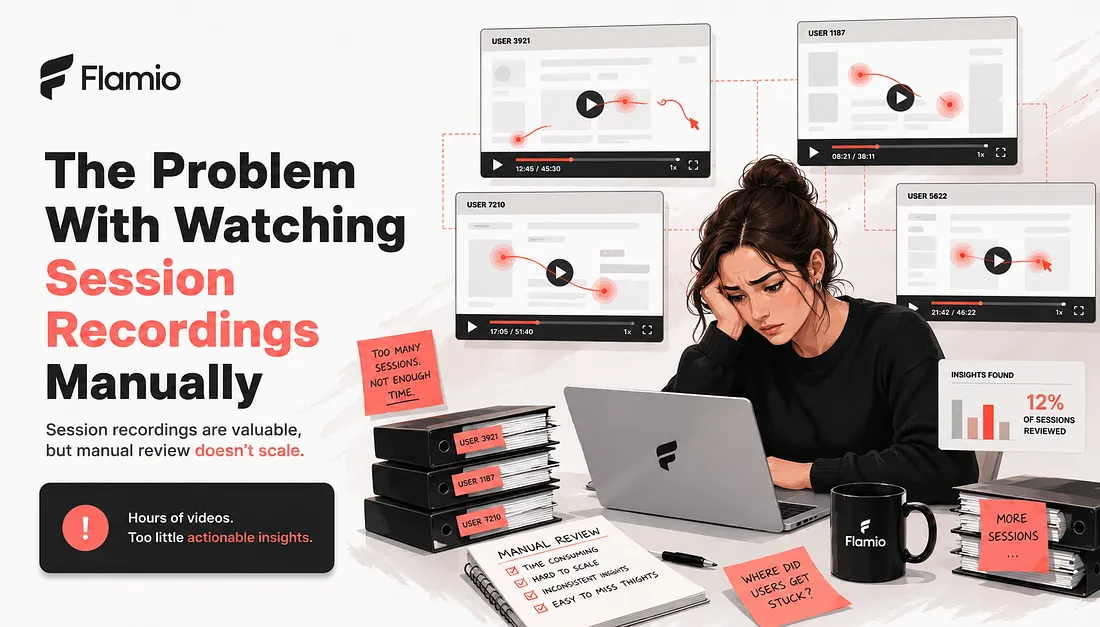
Session replay solved an important problem: it let product teams see what users actually did. Then it created another one. A company installs a recording tool. Within days, it has hundreds of sessions. Within weeks, perhaps thousands. Somewhere inside that growing archive is the moment a user misunderstood the pricing page, clicked an unresponsive button, hesitated over a form field, or took a route nobody on the product team expected. The evidence exists. The team simply does not have time to find it. Recordings were useful when the main challenge was visibility. Today, visibility is abundant. The new bottleneck is interpretation.
Recording users is no longer the difficult part
Capturing behaviour has become routine. Product teams can collect clicks, scrolls, navigation events, console errors, page performance, form interactions, and full user recordings. That sounds like progress, and it is. But more behaviour data does not automatically produce more user understanding. A recording shows one person moving through one version of a product at one moment in time. It does not tell the team whether the behaviour was unusual, whether it happened repeatedly, whether it affected an important flow, or whether it deserves engineering attention. That work still happens in someone's head. A product manager opens a recording and watches a user move through onboarding. Nothing interesting happens for two minutes. Another session starts. The user pauses, scrolls back, clicks the same control twice, and eventually continues. Was that hesitation meaningful? Was the user reading carefully? Was the button unclear? Did other people behave the same way? One recording rarely answers the question. So the product manager opens another. Then another. This is the hidden cost of traditional session replay. The software records at machine scale, while the interpretation still happens at human speed. In practice, large recording libraries are often reviewed only when something has already gone wrong. A conversion number drops. Support tickets increase. A customer complains. Only then does someone search through the archive, hoping to reconstruct the cause. The underlying problem is not a lack of evidence, but the hours of mostly uneventful playback required to find the few seconds that matter.
A replay is evidence, not an insight
Product teams often speak about session recordings as if the recording itself were the outcome. "We have replay installed." "We can watch users." "We have the data." But having a security camera does not mean you understand what happened in the building. A recording is a source. An insight is an interpretation supported by that source. The difference matters. Imagine ten users attempting to complete a checkout flow. Three pause at the delivery options. Two click a disabled-looking control that is actually active. One returns to the basket before continuing. Four complete the flow without visible difficulty. A replay tool can faithfully show all ten journeys. The product team still needs to determine which behaviours represent genuine friction, which are harmless variations, where users moved away from the intended journey, which issue affected several people rather than one, and what the team should change first. These are behavioural analysis questions, not recording questions. The future of session replay is therefore not a better video player. It is a layer that can move between individual evidence and patterns across many sessions.
The useful unit is the moment that deserves attention
Manual replay encourages a strange workflow. Teams begin with a session and hope to discover a problem. A more useful workflow begins with a possible problem and takes the team directly to the supporting sessions. Instead of selecting a random recording from a list, the team should be able to ask: show me sessions where users hesitated before submitting the form. Which users clicked something the page did not respond to? Where did people leave the expected onboarding flow? Did this issue occur once, or does it repeat across users? This changes replay from passive storage into active research. The recording still matters. In fact, it becomes more valuable because it is attached to a specific finding. Rather than watching ten minutes to understand the context, a designer can jump directly to the exact moment, inspect what happened before and after, and decide whether the interpretation is credible. AI UX research should not remove the evidence. It should remove the search for evidence. That distinction is important. A summary without a recording can become an unsupported opinion. A recording without a summary becomes homework. The useful product connects the two.
Automation should reduce review, not remove judgement
There is an understandable concern around UX research automation: if software interprets behaviour, will teams stop thinking critically? That would be a bad outcome. The purpose of UX AI should not be to make product decisions autonomously. It should reduce the mechanical work required before a good decision can be made. A useful system can detect a cluster of dead clicks, repeated pauses, U-turns, or unexpected navigation. It can group similar events, estimate their importance, suggest a likely cause, and surface the relevant recordings. A person still needs to judge the product context. Perhaps users pause because the information is important, not because the interface is confusing. Perhaps an alternative route is perfectly valid. Perhaps a control appears broken in a recording but behaved correctly. Automation should narrow the field. It should tell the team, "These are the sessions worth reviewing, and this is why." It should not pretend that human behaviour is always unambiguous. The goal is not to eliminate research. It is to stop spending research time on playback that produces no insight.
From replay to structured user understanding
This is the problem Flamio is designed around. Flamio does not treat session replay as the final product. Recordings are behavioural evidence that can be analysed, compared, grouped, and turned into findings. With Flamio Vision, a product owner can define a task and record a Happy Path, the intended journey through a flow such as onboarding, checkout, or search. Real participant sessions can then be compared against that route step by step, helping identify where people diverged and why. The system also computes per-session signals such as dead clicks, rage clicks, U-turns, and long pauses, even before a deeper AI analysis is run. This gives the analysis something session replay usually lacks: context. A pause has a different meaning when it happens immediately before a required action. A detour matters more when it moves the user away from the outcome they were trying to reach. A click becomes meaningful when the interface fails to respond and the same behaviour appears in other sessions. For live products, Flamio OnLive applies a similar principle to production traffic. It detects struggle signals including hesitation, dead clicks, U-turns, inactivity, slow page loads, and form-field friction. Individual struggle moments are aggregated into issues by page, signal, and element, with affected sessions and severity available for review. The result is not simply "here are your recordings." It is closer to: here is a recurring problem, here is where it happens, here are the users affected, and here is the exact evidence behind the finding. Flamio's reporting model is built around complete findings: what is wrong, where it occurs, the evidence supporting it, why it matters, and a suggested action. The replay remains available as proof rather than becoming another archive the team has to search manually. That is also why Flamio is not positioned as another session replay platform or analytics dashboard. Its broader direction is an intelligence layer between digital interfaces and human behaviour, helping teams move from what happened to why it happened and what should be improved next.
The recording is becoming the supporting material
Session replay is not disappearing. Manual session replay is. Teams will still inspect individual user recordings when context matters. Researchers will still notice details that automated systems miss. Designers will still want to see the interface through a user's actions rather than through a chart. But watching recordings should become the verification step, not the discovery process. The shift is from "Which sessions should we watch?" to "Which problems deserve our attention, and what evidence supports them?" That is a much more useful question. The next generation of behavioural tools will not win by recording more sessions. They will win by helping teams understand more of what those sessions mean, while asking humans to spend their limited attention only where judgement is truly needed.
Takeaway
Session replay is not disappearing. Manual session replay is. The next generation of behavioural tools will help teams understand what recordings mean, while sending human attention only to the evidence that deserves judgement.
More Flamio notes
The Best AI UX Research Will Start With Behaviour, Not Prompts
AI UX research becomes more useful when it starts from real user behavior, intended journeys, and friction patterns rather than isolated interface prompts.
Founder notesBefore You Hire a UX Researcher, Test One Flow
Early teams can learn a surprising amount by testing one critical flow before building a large research process or hiring a dedicated researcher.
ResearchA Small UX Test Beats a Big Internal Debate
Short user tests help product teams replace opinion loops with real evidence from the people trying to use the product.