

How 2-minute user tests can change product decisions
Short, focused usability tests help teams escape opinion loops and make product decisions from real user behavior instead of internal assumptions.
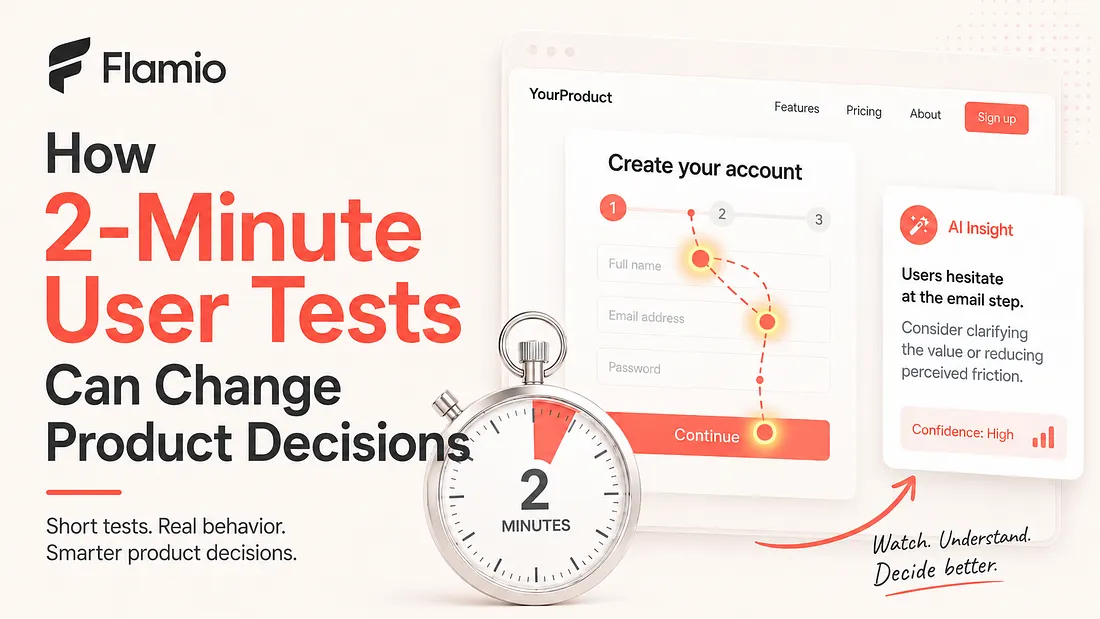
Most product decisions are made with less certainty than teams like to admit. A founder changes the onboarding flow because it "feels too long." A designer rearranges a pricing page because the current version "looks confusing." A product manager pushes a feature higher in the interface because users "probably need it sooner." Everyone has a reason. Everyone has a theory. But in early-stage products, theory is usually more available than evidence. This is where short user testing becomes incredibly useful. A usability test does not always need to be a formal research project with recruitment, scripts, long sessions, analysis workshops, and polished reports. Sometimes, the most valuable thing a team can do is watch a real person try to complete one specific action for two minutes. Not twenty minutes. Not a full product walkthrough. Just two focused minutes on one flow, one feature, or one idea. Those two minutes can expose more than a week of internal discussion.
The problem with product decisions made in isolation
When you know where every button is, every step feels obvious. When you helped design the flow, the logic feels natural. When you understand the business model, the pricing page makes sense. But users do not arrive with that context. They arrive with a goal, a limited attention span, and very little patience for figuring out what your interface is trying to say. This is especially painful for startups. Early-stage teams move fast, but they often move with incomplete feedback. They ship landing pages, onboarding flows, checkout pages, dashboards, and new features while still trying to understand what users actually need. At that stage, every product decision matters because every point of friction can affect activation, conversion, retention, or trust. The challenge is that most teams do not have time for a heavy UX research process before every decision. They cannot pause for weeks every time they want to validate a new screen. But the opposite approach, making decisions only from internal opinions, is just as risky. That is why short user testing is so powerful. It gives teams a way to check reality quickly.
What a 2-minute user test actually means
A 2-minute user test is not a replacement for deep UX research. It is a lightweight validation method for checking a very specific question. Can a user understand what this page is for? Can they find the next step in the onboarding flow? Do they notice the new feature? Can they complete a core action without help? Do they understand what they are supposed to do after signup? These are not abstract questions. They are practical product decisions waiting to happen. Instead of asking users what they think about a flow, you ask them to use it. You give them a task and observe what happens. Where do they pause? What do they ignore? What do they click first? What do they misunderstand? What do they try to do that the interface does not support? A short usability test works because many product problems reveal themselves quickly. If a user cannot understand the main action within the first minute, that is useful evidence. If they hesitate before clicking a button, that hesitation matters. If they scroll past the thing you expected them to notice, that tells you something. If they ask a question that the interface should have answered, the design has a communication problem. Two minutes is often enough to show where confidence ends and friction begins.
Small tests are perfect for specific flows
A common mistake is trying to test too much at once. Teams ask users to review the whole product, comment on every screen, and explain their overall impressions. The session becomes broad, messy, and hard to act on. The team ends up with vague feedback like "it looks good," "maybe this could be clearer," or "I would probably use this." That kind of feedback is not useless, but it rarely changes product decisions with confidence. Short user tests work better when they are narrow. A team can test one signup flow, one pricing section, one dashboard action, one empty state, one checkout step, or one new feature entry point. The smaller the scope, the clearer the learning. For example, imagine a startup debating whether its onboarding should ask users to connect an integration immediately or let them explore the product first. Internally, both arguments sound reasonable. Connecting early may improve setup quality, but it may also create friction before users see value. A 2-minute test can make the discussion more concrete. Give a user the onboarding flow and ask them to get started. Watch what happens when the integration step appears. Do they understand why it is needed? Do they hesitate? Do they skip it? Do they look worried about permissions? Do they lose momentum? That short observation can shift the decision from "which option do we prefer?" to "which option creates less friction for real users?" That is the entire point of UX validation.
User testing helps teams escape opinion loops
One person thinks the CTA should say "Get Started." Another thinks it should say "Create Account." Someone else wants to add more explanation before the button. Another person thinks the page already has too much text. Everyone is trying to help, but without evidence, the conversation becomes a battle of preferences. User testing changes the energy of that conversation. When a real user fails to understand the page, the issue becomes harder to ignore. When several users pause at the same step, the problem becomes visible. When users successfully complete a flow that the team was worried about, that also matters. Good user testing does not only reveal problems. It also prevents teams from "fixing" things that are already working. This is important because startup UX is not just about making interfaces prettier. It is about reducing uncertainty in product decisions. A short usability test gives teams a small but meaningful piece of behavioural evidence. That evidence can support a redesign, prevent unnecessary changes, clarify a roadmap decision, or reveal that a feature idea is not as obvious as the team thought. The test does not need to be perfect. It needs to be specific enough to answer the decision in front of the team.
The best user tests focus on behaviour, not praise
There is a big difference between asking "Do you like this?" and watching whether someone can use it. Users are often polite. They may say a design looks good because they do not want to sound critical. They may say they understand a feature because admitting confusion feels awkward. They may say they would use something because the idea sounds useful in theory. Behaviour is harder to fake. A user either finds the next step or does not. They either understand the task or get stuck. They either notice the feature or miss it. They either complete the flow smoothly or need to slow down and figure things out. This is why user testing should focus less on opinions and more on actions. For a 2-minute test, the question is not "What do you think of this screen?" The better prompt is "Try to create your first project," or "Find where you would invite a teammate," or "Choose the plan you would start with," or "Complete this checkout." The value comes from the gap between what the product expects users to do and what users actually do.
Short tests lower the cost of learning
One reason teams avoid usability tests is that they imagine research as a large, slow process. In some cases, it should be. Complex products, high-risk decisions, and major strategic questions deserve deeper research. But not every decision needs that level of effort. Many startup product decisions are small, frequent, and urgent. Should this step come before or after signup? Is this feature visible enough? Is the empty state clear? Does the pricing page explain the value fast enough? Does the onboarding flow ask too much too early? These questions do not always require a full research cycle. They require fast learning. A short user test makes learning cheap enough to happen regularly. That is the real advantage. When testing becomes lightweight, teams stop treating UX validation as a special event and start treating it as part of product iteration. Instead of waiting until after launch to discover confusion, teams can test before committing engineering time. Instead of debating every detail internally, they can watch a few users interact with the flow. Instead of assuming a feature is clear, they can check whether people understand it in practice. The faster the feedback loop, the easier it becomes to make better product decisions.
What teams can learn in two minutes
A short test will not tell you everything about your product, but it can reveal the problems that matter early. It can show whether the first screen explains enough. It can show whether users understand the main action. It can show where attention goes. It can show whether users follow the intended path or create their own. It can show whether copy is doing its job. It can show whether the interface creates confidence or hesitation. Hesitation is one of the most important signals in startup UX. Users do not always abandon because they hate a product. Often, they abandon because the next step feels unclear, risky, too much work, or not worth the effort yet. A 2-minute test can reveal these moments before they become conversion problems. For example, if users pause on a signup form because they do not understand why a certain field is required, the fix may be simple. If users do not click a key feature because it looks disabled, the visual design needs attention. If users ignore a value proposition because it is buried below generic messaging, the page needs stronger hierarchy. These are not huge research conclusions. They are practical product improvements. And practical improvements are exactly what early-stage teams need.
How to make short user tests useful
The quality of a short usability test depends on how focused it is. Start with one decision. Do not test the whole product. Test the exact flow that is creating uncertainty. Then define the user task in plain language. The task should describe the user goal, not the interface action you want them to take. For example, instead of saying "Click the invite button," ask the user to "Add a teammate to this workspace." Instead of saying "Go to the billing page," ask them to "Find where you would change your plan." This avoids leading the user and gives you a cleaner view of how they interpret the product. During the test, do not explain the interface. The urge to help is strong, especially when users struggle, but that struggle is the data. If you guide them through the flow, you are testing your explanation, not the product. After the test, look for patterns. One user getting confused may be a signal. Three users getting confused in the same place is a product decision waiting to happen. The goal is not to collect endless notes. The goal is to identify what should change next.
From short user tests to clear product direction
This is the kind of problem Flamio is being built around. Many product teams already know they should test flows more often, but the manual work gets in the way. Watching recordings, identifying hesitation, interpreting friction, and turning observations into product decisions can take more time than early-stage teams have. Flamio focuses on helping teams move from raw user behaviour to clearer UX insights faster. According to its current positioning, Flamio is designed as an AI UX research assistant that watches user behaviour, detects friction, and turns recordings into actionable product decisions. The goal is not to give teams another dashboard full of data, but to help them understand what went wrong, why it matters, and what should be improved next. That makes it especially relevant for short user tests. A founder, designer, or product manager can test one specific flow, observe where users hesitate, and use Flamio to help interpret the behaviour. Instead of leaving the session with scattered notes, the team can move toward a clearer insight report and a more confident next step. Flamio early approach also reflects this hands-on validation mindset. The product strategy emphasizes helping users set up one test flow, reviewing results, collecting feedback, and learning directly from real usage. That is exactly what short usability tests should do for startups: reduce assumptions, expose friction, and turn small moments of user behaviour into better product decisions.
Takeaway
Short user tests help teams reduce assumptions, expose friction, and turn small moments of real user behaviour into better product decisions.
More Flamio notes
The End of Watching Session Replays by Hand
Session replay gave teams visibility, but the next product advantage is finding the moments that deserve attention without watching hours of playback.
AI insightsThe Best AI UX Research Will Start With Behaviour, Not Prompts
AI UX research becomes more useful when it starts from real user behavior, intended journeys, and friction patterns rather than isolated interface prompts.
Founder notesBefore You Hire a UX Researcher, Test One Flow
Early teams can learn a surprising amount by testing one critical flow before building a large research process or hiring a dedicated researcher.