

Why product designers need to think like researchers
Product designers need research thinking to understand user behaviour, challenge assumptions, and connect design decisions to real product outcomes.
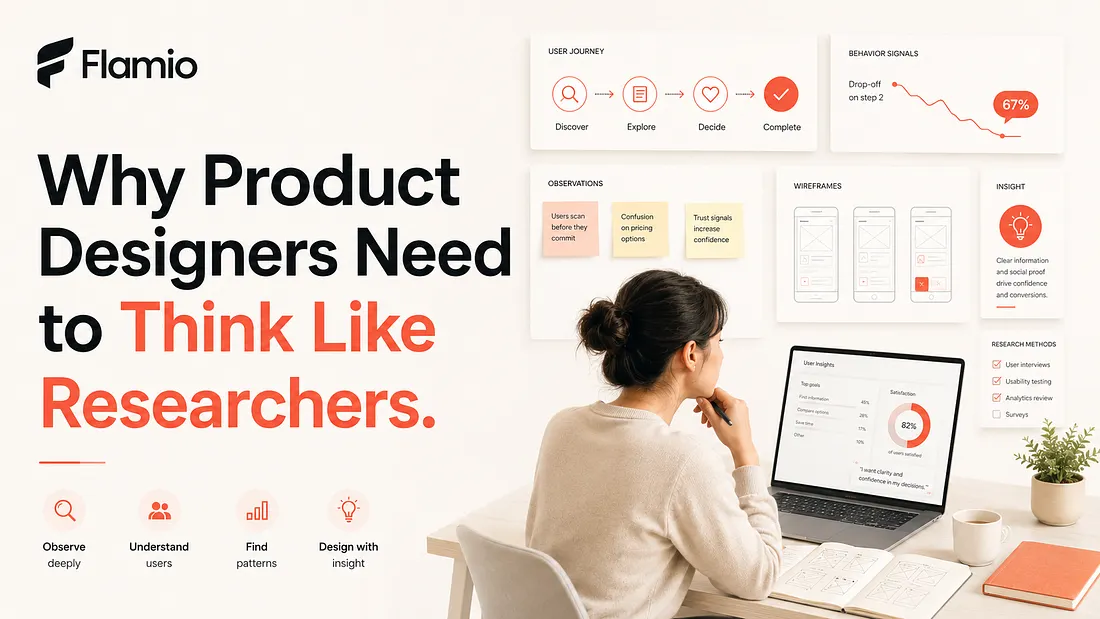
Product design is often misunderstood as the craft of making interfaces look clean, modern, and usable. That is part of the job, but it is not the whole job. A good product designer does not only draw screens. They shape how people move through a product, how they understand information, where they hesitate, what they ignore, and what decisions they make next. This is why product designers need to think like researchers. Product design is not only about creating an interface. It is about understanding user behaviour well enough to make better product decisions. A button, a form, a navigation pattern, or an onboarding step is never just a visual element. Each one changes how users think, act, and feel inside a product. When designers ignore that, they may still create something beautiful. But beautiful does not always mean clear. Polished does not always mean effective. And a smooth-looking flow can still quietly lose users if nobody understands what is happening beneath the surface.
Design is not decoration
There is still a common idea that design comes after the "real" product work. The strategy is defined, the features are chosen, the product logic is built, and then designers are asked to make everything look better. That mindset creates weak products. Product design should not be treated as a visual layer placed on top of decisions that have already been made. Design is part of how those decisions are tested, challenged, and improved. Every design choice contains an assumption about how users behave. When a product designer places a call-to-action at the end of a page, they are assuming users will read enough context before acting. When they simplify a signup form, they are assuming friction matters more than collecting extra information. When they hide advanced settings, they are assuming most users need focus more than control. These assumptions may be right. They may also be wrong. The only way to know is to think like a researcher.
Product designers work with behaviour, not screens
A screen is only a snapshot. A flow is where the real product experience happens. Users do not experience products as isolated UI pieces. They experience sequences. They land somewhere, scan quickly, try to understand what is expected, make small decisions, recover from confusion, compare options, and either continue or leave. That means product designers need to think beyond individual screens. They need to understand the consequences of movement from one step to another. A checkout page is not just a checkout page. It is the result of everything that happened before it. Did the user understand the offer? Did they trust the product? Did they feel rushed? Did they know what would happen after payment? Did they hit a moment of hesitation that the team never noticed? The same is true for onboarding, dashboards, settings, search, pricing pages, and feature adoption. The interface is visible, but user behaviour tells the real story. This is where UX research becomes part of product design, not a separate activity reserved for large teams. Designers who understand behaviour can see problems earlier. They ask better questions. They avoid designing from personal taste. They build flows around evidence instead of assumption.
Design thinking needs evidence
Design thinking is useful because it pushes teams to understand the problem before jumping into solutions. But in practice, many teams rush through that part. They create personas, write problem statements, map journeys, and then move quickly into wireframes. The process looks thoughtful, but the actual evidence behind it can be thin. This is dangerous because product teams are very good at convincing themselves that their logic makes sense. A flow may look obvious to the team because the team already knows the product. A feature may feel simple because everyone in the room understands the business model. A label may feel clear because it has been discussed internally for weeks. Users do not have that context. A research-minded product designer stays aware of this gap. They do not ask only, "Does this screen look good?" They ask, "What will the user understand here?" "Where could they hesitate?" "What are we asking them to believe?" "What happens if they miss this message?" "What behaviour are we trying to create?" Those questions change the quality of design decisions.
The best designers are comfortable being wrong
One of the most important traits of a strong product designer is the ability to let go of a favorite idea when user behaviour proves it wrong. That sounds simple, but it is not easy. Designers invest time, taste, and logic into their work. A flow can feel elegant. A layout can feel balanced. A concept can feel smart. But users are not obligated to behave the way the designer expected. Research helps designers stay honest. A researcher mindset does not mean treating every opinion as invalid. It means understanding that real behaviour matters more than internal confidence. When users skip an explanation, misunderstand a button, abandon a form, or repeatedly take the wrong path, the designer has learned something valuable. That learning is not a failure. It is the point. Good product design gets stronger through contact with real users. The earlier that contact happens, the less expensive mistakes become.
Research makes designers more strategic
Some designers worry that research slows them down or makes the process too formal. In reality, research often makes product design faster because it reduces guessing. Without behavioural evidence, teams spend too much time debating preferences. One person prefers a shorter flow. Another wants more context. Someone wants the CTA higher. Someone else thinks users need more trust signals. These conversations can go in circles because everyone is arguing from opinion. User behaviour changes the conversation. Instead of asking who has the stronger opinion, the team can ask what users actually do. Where do they stop? Which parts do they ignore? Which steps create confusion? Which decision points cause hesitation? This makes the product designer more strategic. They are not just delivering screens. They are helping the team understand why a product works or does not work. They can connect design decisions to activation, conversion, retention, and product growth. That is a much stronger role than "making it look nice."
Product designers need to understand consequences
Every design decision creates consequences. Adding more explanation can increase clarity, but it can also create cognitive load. Reducing steps can make a flow faster, but it can also remove confidence-building moments. Making a CTA more prominent can increase clicks, but it can also push users forward before they are ready. Hiding complexity can simplify the experience, but it can also make advanced users feel limited. There is rarely a perfect design decision. There are only trade-offs. A research-minded product designer understands this. They do not chase abstract best practices without context. They look at how a decision affects behaviour inside a specific product, for a specific user, at a specific moment.
Why this matters more in early-stage products
For early-stage products, the cost of wrong assumptions is especially high. Small teams often do not have huge traffic, large research departments, or months to refine every flow. They need to learn quickly. They need to understand why users drop off, why they do not activate, why they do not understand the value, or why they fail to reach the "aha" moment. This is exactly where product designers can have an outsized impact. A designer who thinks like a researcher can help the team test flows before they become deeply baked into the product. They can catch confusion before it becomes UX debt. They can turn vague feedback into sharper product questions. They can help founders and product managers understand not just what users say, but what users actually do. In early-stage product design, speed matters. But speed without learning only helps teams build the wrong thing faster.
The future product designer is part designer, part researcher
The role of the product designer is expanding. It is no longer enough to create clean interfaces, prepare design systems, and hand off polished screens. Modern product designers need to understand behaviour, psychology, product strategy, UX research, and the business impact of design decisions. This does not mean every designer needs to become a full-time researcher. It means research thinking should become part of their everyday work. Before designing a flow, they should ask what assumptions need to be tested. While designing, they should think about likely user behaviour. After release, they should look for signs of friction, confusion, and drop-off. The best designers build a loop between design decisions and user evidence. That loop is where better products come from.
A smarter way to understand product flows
The core problem is simple: many teams still make design decisions without enough behavioural evidence. Designers are expected to create flows, improve conversion, support product growth, and defend UX recommendations, but they often lack fast ways to understand what users are actually doing. Flamio is built around this exact gap. It focuses on turning user behaviour into actionable UX insights, helping teams understand where users hesitate, where flows create friction, and what should be improved next. Its positioning is not just about showing raw analytics, but about helping product teams interpret behaviour and make clearer product decisions. This matters because the future of product design is not only about better-looking interfaces. It is about interfaces that understand humans better. Flamio broader vision is to become an intelligence layer between digital interfaces and human behaviour, helping teams move from static design decisions toward more adaptive, behaviour-aware product experiences. For product designers, that shift is important. The strongest designers will not be the ones who only create the cleanest screens. They will be the ones who understand what those screens make people do.
Takeaway
The strongest product designers do more than create clean screens. They understand the behaviour those screens create and use evidence to make better product decisions.
More Flamio notes
The End of Watching Session Replays by Hand
Session replay gave teams visibility, but the next product advantage is finding the moments that deserve attention without watching hours of playback.
AI insightsThe Best AI UX Research Will Start With Behaviour, Not Prompts
AI UX research becomes more useful when it starts from real user behavior, intended journeys, and friction patterns rather than isolated interface prompts.
Founder notesBefore You Hire a UX Researcher, Test One Flow
Early teams can learn a surprising amount by testing one critical flow before building a large research process or hiring a dedicated researcher.