

The Future of UX Research Is Faster Feedback Loops
UX research cannot stay separate from product iteration. Modern teams need faster feedback loops that help them learn as quickly as they ship.
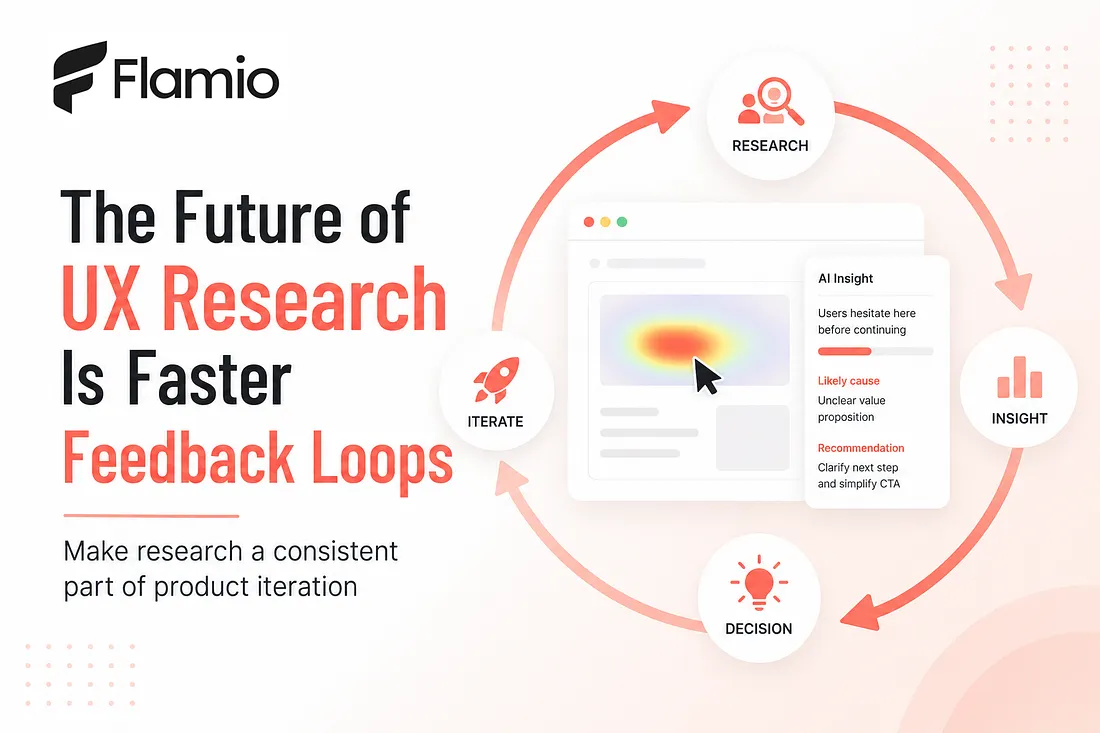
For a long time, UX research has been treated like a special event. A team prepares a study, recruits participants, runs interviews or usability sessions, writes a report, presents the findings, and then everyone moves on. The research becomes a milestone in the product process rather than a constant part of it. That worked better when product cycles were slower. Teams had more time between releases, competition moved at a different pace, and user expectations changed less dramatically. But startup product development does not work like that anymore. Products change weekly, sometimes daily. Onboarding flows are rewritten. Pricing pages are tested. Features are launched, removed, renamed, and rebuilt. The product is always moving. The problem is that many UX research processes are still built for a slower world. Today, the future of UX research is not just better studies or cleaner reports. It is faster feedback loops.
UX research cannot stay separate from product iteration
UX research is most valuable when it influences decisions while those decisions are still flexible. Too often, research happens before a product is built or after something has already gone wrong. A startup validates an idea before launch, then disappears into months of building. Later, when activation is low or users do not convert, the team returns to research to figure out what happened. By then, the cost of learning is higher. This is where many product teams get stuck. They do not necessarily ignore users. They simply do not hear from them often enough. Feedback arrives late, gets filtered through assumptions, or sits in scattered notes that never fully reach the product roadmap. In fast-moving teams, UX research has to become part of the operating rhythm. It should not be a one-time checkpoint. It should be connected to every meaningful product iteration. Every new onboarding step, landing page, dashboard, checkout flow, signup form, or feature release creates new user behaviour. That behaviour contains answers. Where do users hesitate? What do they misunderstand? What feels obvious to the team but confusing to a new visitor? What looks like a technical issue but is actually a trust issue? These questions cannot be answered once and then forgotten. They need to be answered continuously.
Feedback loops are the real product advantage
A feedback loop is simple in theory: build something, observe how users respond, learn from that response, and improve the product. The faster and more consistently this happens, the better the product becomes. In practice, many startups have broken feedback loops. They ship updates quickly, but the learning does not move at the same speed. Analytics may show where users drop off, but not why they dropped off. Support tickets may reveal pain points, but only from users motivated enough to complain. Founder intuition may help in the early days, but it becomes risky when the product grows beyond the founder personal understanding. This is why UX research matters so much in product iteration. It gives teams the human context behind the numbers. A drop-off rate tells you that something happened. UX research helps explain what the user experienced before it happened. Maybe the page asked for too much information too early. Maybe the copy created doubt. Maybe the next step was visually hidden. Maybe users understood the feature, but not the value. These are not just interface problems. They are product problems. The best startup teams do not wait for quarterly research cycles to notice these things. They build systems that make learning continuous.
Continuous discovery is not just for big teams
Continuous discovery is often discussed as if it belongs to mature product organizations with dedicated researchers, large user panels, and well-defined processes. But the need is even more urgent in startups. Startups live under uncertainty. They rarely have enough users, time, or budget to make decisions slowly. They need to learn from every interaction. A founder watching five users struggle with onboarding may gain more useful insight than a polished dashboard viewed in isolation. A product designer reviewing real behavior after a launch can often spot problems that were invisible during design review. The challenge is consistency. Everyone agrees that talking to users is important. Everyone agrees that research should guide decisions. But when deadlines arrive, UX research is often the first thing to shrink. Teams rely on assumptions because assumptions are faster in the moment, even when they become expensive later. The future of UX research depends on reducing that friction. Research has to become easier to run, easier to interpret, and easier to connect with product decisions. It has to fit naturally into the way teams already build. Not every iteration needs a huge research project. Sometimes the most useful question is narrow: did users understand this flow? Did they know what to do next? Did the new version reduce hesitation? Did the change create a new point of friction? Small research moments, repeated often, can create a much stronger product culture than occasional large studies.
From research reports to product decisions
One reason UX research gets disconnected from product iteration is that the output is often too far away from the decision. A long research report may be thoughtful, accurate, and beautifully structured. But if it arrives after the roadmap is already locked, its influence is limited. If findings are too abstract, teams may agree with them without knowing what to change. If insights are not tied to specific flows or behaviours, they can become interesting but inactive. The next stage of UX research needs to be more decision-oriented. Product teams do not only need to know that users are confused. They need to know where confusion appears, why it matters, and what should be improved next. They need research that can move directly into prioritization, design changes, copy revisions, and product experiments. This does not make UX research less strategic. It makes it more useful. The strongest research cultures do not separate learning from shipping. They treat every product release as an opportunity to understand users better. Every iteration becomes a question. Every user session becomes evidence. Every friction point becomes a chance to improve the product. This is especially important in startup product development, where speed can easily become chaos. Fast teams need more user understanding, not less. Without feedback loops, speed only helps teams build the wrong thing faster.
UX research becomes infrastructure
The most important shift is mental. UX research should not be seen as a department, phase, or deliverable. It should become infrastructure for product development. Infrastructure is always there. It supports the system in the background. It does not need to be rediscovered every time a team wants to make a decision. In the same way, user understanding should be continuously available to founders, designers, product managers, and engineers. When UX research becomes infrastructure, product conversations change. Instead of asking, "What do we think users want?" teams ask, "What have we observed recently?" Instead of debating opinions, they look for behavioural evidence. Instead of waiting for a major redesign, they make smaller improvements more often. This creates a healthier product culture. It reduces guesswork. It makes decisions less political. It helps teams move faster without losing touch with the people they are building for. That is the real promise of faster feedback loops. They do not just speed up research. They improve the quality of product iteration.
How modern software approaches this problem
Flamio is built around the belief that product teams need faster, more consistent user understanding. Its strategy is not to become another dashboard or another place where teams collect passive data. Flamio positioning is centered on turning user behaviour into clear UX insight, helping teams understand friction, hesitation, confusion, and behavioural patterns inside real product flows. This matters because the bottleneck in modern UX research is rarely the lack of data. Most teams already have more signals than they can process. The harder problem is interpretation. Teams need to understand what went wrong, why it matters, and what should be improved next. Flamio early direction focuses exactly on that gap: helping startups, product designers, UX designers, and product managers analyze behaviour faster and turn recordings into actionable product decisions. In practice, this means UX research can become part of the product iteration cycle instead of sitting outside it. A team can test a flow, observe real behaviour, detect friction, collect feedback, and use those findings to improve the next version. That makes research less like a one-time project and more like a continuous discovery engine.
The future belongs to teams that learn as quickly as they ship
The future of UX research belongs to teams that learn as quickly as they ship. Products will keep moving faster, user expectations will keep rising, and startup teams will keep working under pressure. The winners will not be the teams with the most assumptions or the biggest backlog. They will be the teams with the tightest feedback loops. That is the direction Flamio is building toward: helping interfaces understand humans faster, so product teams can build with more evidence, more confidence, and less guesswork.
Takeaway
The future of UX research is not just better studies or cleaner reports. It is faster feedback loops that keep user understanding connected to product iteration.
More Flamio notes
The End of Watching Session Replays by Hand
Session replay gave teams visibility, but the next product advantage is finding the moments that deserve attention without watching hours of playback.
AI insightsThe Best AI UX Research Will Start With Behaviour, Not Prompts
AI UX research becomes more useful when it starts from real user behavior, intended journeys, and friction patterns rather than isolated interface prompts.
Founder notesBefore You Hire a UX Researcher, Test One Flow
Early teams can learn a surprising amount by testing one critical flow before building a large research process or hiring a dedicated researcher.