

The Hidden Cost of "Looks Good" Feedback
Polite feedback can hide real UX risk. Products need behavioral evidence, not only positive reactions from people reviewing a screen.
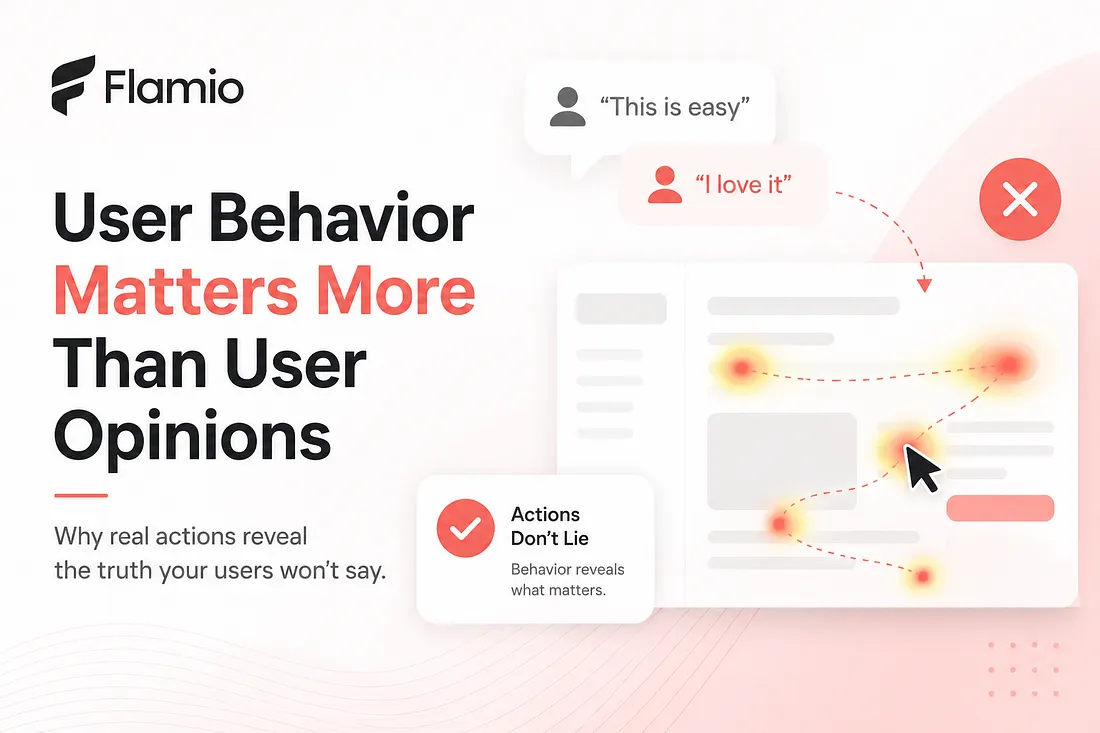
"Looks good" is one of the most dangerous phrases in early product work. It feels useful. It feels positive. It gives the team a little confidence before launch, before the investor update, before the next sprint planning session. Someone opens the landing page, clicks around for two minutes, says the design feels clean, and everyone relaxes. The problem is that nothing has really been validated. Most "looks good" feedback is not dishonest. It is just too easy. Teammates want to be supportive. Friends do not want to be harsh. Early users often respond to the version of the product you explained to them, not the product they actually had to understand on their own. That distinction matters. A product can look good and still confuse people. A flow can feel polished and still make users hesitate. A button can be visually clear to the designer and invisible to someone trying to finish a task. A pricing page can get compliments and still fail to help a buyer decide. This is the hidden cost of opinion-based product feedback. It reassures the team while leaving the real friction untouched.
The comfort of opinions
Startups often collect feedback in the fastest possible way because speed is part of the culture. Send a link in Slack. Ask a few friends. Show the new flow to another founder. Drop the prototype into a community. Ask, "What do you think?" The answers usually sound useful at first. "The layout is nice." "I like the concept." "The onboarding seems clear." "The product makes sense." But these comments are rarely connected to a real task. The person giving feedback is not trying to solve a problem under normal conditions. They are reviewing the product as a favor, often while knowing what the team is trying to build. That creates a strange kind of theatre. The user is not behaving like a user. The founder is not observing like a researcher. The product is not being tested against reality. Everyone is participating in a lightweight social ritual where the safest answer is some version of encouragement. This is especially common in startup feedback loops. Early teams ask for opinions because opinions are quick to collect. Real UX validation feels slower. Usability testing sounds heavy. AI UX research tools are still new. Many teams do not have UX researchers in-house, and even when they do, there is rarely enough time to test every onboarding flow, dashboard, checkout step, or feature release properly. So teams settle for reassurance. The cost shows up later.
Users rarely say what their behaviour already showed
A user may say the signup flow was simple, but the recording shows they paused on the password field, clicked the disabled button twice, opened another tab, returned, then completed the form only after guessing what was wrong. A teammate may say the dashboard looks intuitive, but a first-time user spends thirty seconds moving the cursor across the screen, not knowing whether the empty state is clickable. A friend may say the landing page explains the product well, but a real visitor scrolls past the key section, reads the hero twice, hovers near the CTA, and leaves. This is why user behaviour is often more valuable than product feedback in its raw opinion form. People explain their experience after the fact. Behaviour shows the experience while it is happening. The gap between those two things is where friction lives. Good UX researchers know this instinctively. A usability test is not valuable because someone tells you whether they like the interface. It is valuable because you see where expectation and reality diverge. You notice the hesitation before the click. You see the detour. You watch the user recover from confusion, or fail to recover at all. The product team's job is not to collect compliments. It is to understand where the user's mental model breaks.
"Looks good" is not the same as "works well"
The phrase "looks good" usually evaluates presentation. It says something about surface quality, visual taste, and general impression. But products do not win only because they look good. They win because people can use them to get somewhere. A clean onboarding flow still has to answer: what am I supposed to do next? A beautiful analytics dashboard still has to answer: what matters here? A polished checkout still has to answer: can I trust this enough to complete the purchase? A well-designed SaaS homepage still has to answer: is this for me, and why should I care now? When teams confuse visual approval with UX validation, they often optimize the wrong layer. They change copy because someone felt it was too long. They move buttons because someone liked another layout. They simplify a screen because a stakeholder thought it looked busy. Sometimes those changes help. Often they just reflect the loudest opinion in the room. Evidence-based UX work starts from a different place. It asks what users were trying to do, what the intended path was, where they deviated, where they hesitated, and what that pattern might reveal. That does not mean opinions are useless. They can point toward perception, positioning, language, and trust. But opinions should not be treated as the final proof that a flow works. Behaviour is the stronger signal.
The problem with early feedback is not quantity
Many teams think they need more feedback. Usually, they need better feedback. Ten people saying "looks good" may be less useful than watching three people fail to complete the same task. A long comment thread can be less valuable than one session recording where a user clearly tries the wrong thing three times. A survey can tell you what users remember feeling. A behaviour trace can show where the product made that feeling happen. For founders, this is uncomfortable because behaviour removes some of the ambiguity. It becomes harder to hide behind taste. If users are dropping off, clicking wrong, missing the CTA, or abandoning a key step, the product is giving you a signal. For designers, it can be equally uncomfortable. A screen can be elegant and still not communicate. A component can match the design system and still fail in context. A flow can be logically structured and still not match how users think. That discomfort is useful. It is the beginning of real product learning.
From opinion-based decisions to evidence-based UX
This is where AI UX research starts to become genuinely useful. Not because it replaces UX researchers, product judgment, or customer conversations. It does something more practical: it shortens the distance between what users do and what the team can learn from it. Most teams do not suffer from a lack of signals. They have analytics, recordings, heatmaps, surveys, feedback forms, support messages, sales notes, and founder intuition. The problem is that all of this still leaves the hardest work to the team: making sense of what actually happened. A chart can show that users dropped off. A recording can show that someone clicked around for two minutes. A comment can say that the product felt confusing. But none of that automatically tells the team where the experience broke, why it mattered, or what should be improved first. That is the gap Flamio is built around. Flamio helps teams move away from opinion-based product decisions and closer to evidence-based UX improvements by analysing real user behaviour. Instead of treating feedback as a collection of comments, it looks at what users actually do inside a flow: where they hesitate, where they click wrong, where they drift away from the intended journey, and where friction starts to appear. The useful shift is not just from manual work to automation. It is from vague interpretation to structured understanding.
A better feedback conversation
For example, a team can define the intended user journey, the Happy Path, for a flow like onboarding, checkout, search, or another important product task. Flamio Vision then compares real user behaviour against that intended path and identifies meaningful friction through behavioural and semantic analysis. The output is not just raw playback. It becomes clearer UX insight: friction points, severity, root causes, and recommendations the team can actually discuss. That changes the feedback conversation. Instead of asking, "Do people like this?" the team can ask, "Where did people struggle, and what does their behaviour tell us?" Instead of debating whether a screen feels clear, the team can look at where users slowed down, missed the next step, repeated an action, or abandoned the flow. Instead of making decisions based on the most confident opinion in the room, the team has a better starting point: observed behaviour. That does not remove the need for taste, experience, or human judgment. It makes those things more grounded. A product team still has to decide what to fix, what to ignore, and what tradeoffs to make. But those decisions become stronger when they begin with evidence rather than reassurance.
The future of feedback is behavioural
The best product teams will still talk to users. They will still ask questions. They will still care about opinions, emotions, expectations, and language. But they will stop treating reassurance as validation. The next time someone says "looks good," the right response is not to ignore it. It is to ask what the product still needs to prove. Can a new user complete the task without explanation? Where do they slow down? What do they click before they understand? Which part of the flow creates doubt? Where does confidence disappear? Those answers rarely come from polite comments. They come from watching behaviour closely enough to see what the user could not, or would not, say. A product that looks good may earn attention. A product that works clearly earns trust. And in the end, trust is not built by collecting better compliments. It is built by finding the friction users experience, then removing it before it becomes the reason they leave.
Takeaway
A product that looks good may earn attention. A product that works clearly earns trust. Real validation comes from watching behaviour, not collecting reassurance.
More Flamio notes
The End of Watching Session Replays by Hand
Session replay gave teams visibility, but the next product advantage is finding the moments that deserve attention without watching hours of playback.
AI insightsThe Best AI UX Research Will Start With Behaviour, Not Prompts
AI UX research becomes more useful when it starts from real user behavior, intended journeys, and friction patterns rather than isolated interface prompts.
Founder notesBefore You Hire a UX Researcher, Test One Flow
Early teams can learn a surprising amount by testing one critical flow before building a large research process or hiring a dedicated researcher.