

The Problem With Watching Session Recordings Manually
Session recordings are valuable, but manually watching every user session is becoming one of the slowest ways for modern product teams to understand user behavior.
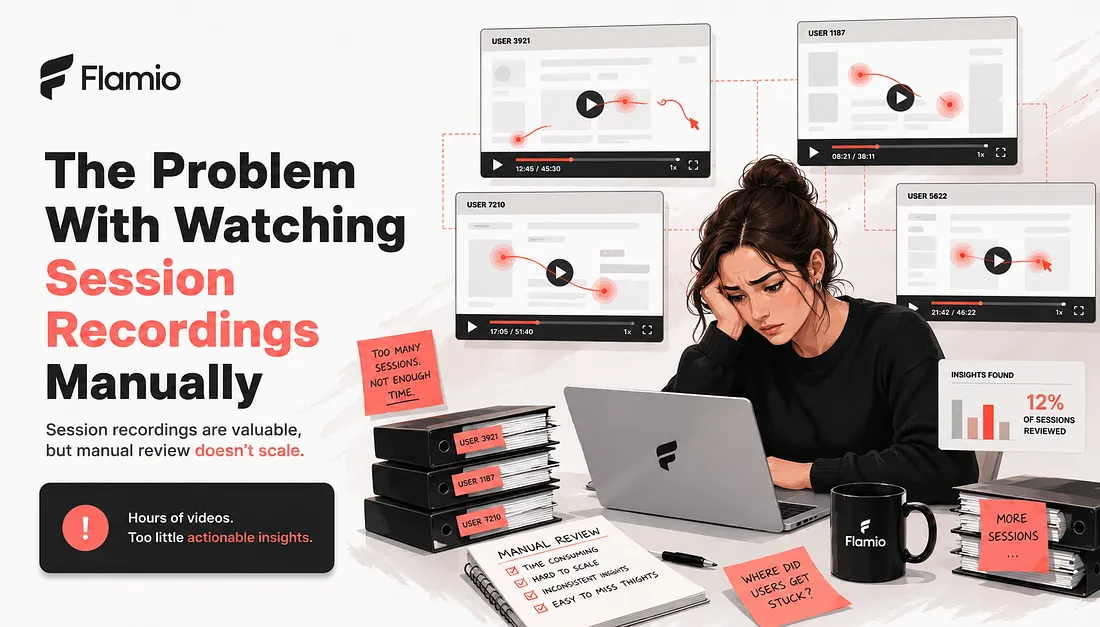
Session recordings are valuable. But for modern product teams, manually watching every user session is becoming one of the slowest ways to understand user behavior. Session recordings became popular because they gave product teams something they could not get from dashboards alone: the ability to see what users actually do inside a product. Not what users say in a survey. Not what a funnel chart suggests. Not what the team assumes from conversion data. Actual behavior.
Session recordings show actual behavior
A user hesitates before clicking a button. They scroll past the most important section. They click something that is not interactive. They move back and forth between two steps. They abandon a flow right before completing the key action. For UX researchers, product designers, founders, and product managers, this kind of visibility can be extremely useful. Session recordings reveal friction that analytics tools often reduce to numbers. They show the human side of product usage: confusion, uncertainty, confidence, hesitation, and failed expectations. But there is a problem. Session recordings are useful only if someone has time to watch them. And for most modern product teams, that is where the system starts to break.
Session recordings create evidence, not insight
A session recording is raw evidence. It shows what happened during a specific user interaction. That makes it valuable, but it also makes it incomplete. The recording itself does not explain whether the user was confused, distracted, exploring, comparing options, or simply moving at their own pace. A long pause might signal hesitation, but it might also mean the user was reading. A dead click might suggest a broken expectation, but it might also be accidental. A user taking a different route through a flow might indicate poor information architecture, or it might simply be a valid alternative path. This is why session recordings require interpretation. Someone has to watch the behavior, understand the task, compare it to the expected flow, identify meaningful moments, ignore noise, and connect repeated patterns across multiple users. That work is not trivial. It requires context, product knowledge, and UX judgment. The problem is not that session recordings are bad. The problem is that they are often treated as if collecting them is the same as understanding users. It is not. A folder full of recordings does not automatically improve the product. A timeline full of clicks does not automatically reveal the cause of friction. A dashboard that stores every session does not automatically tell the team what to fix next. This is where many teams confuse data collection with user behavior analysis.
Manual review does not scale
Watching one or two session recordings can be useful. Watching five can reveal early patterns. Watching twenty can become a serious time investment. Watching hundreds is usually impossible for a busy product team. This is where the manual model breaks down. A product manager may want to understand why activation dropped after a new onboarding release. A designer may want to see how users interact with a redesigned pricing page. A founder may want to know why people visit the product demo page but do not request a call. A UX researcher may want to compare behavior across different user segments. In theory, session recordings can help answer all of these questions. In practice, someone has to sit down and watch them. If each recording is five minutes long, twenty recordings already require more than an hour and a half of raw viewing time. That does not include note-taking, tagging, pattern recognition, writing conclusions, or discussing the findings with the team. If the recordings are longer, the workload grows quickly. This creates a practical limit: teams collect more behavioral data than they can actually analyze. The result is predictable. Session recordings sit inside analytics tools unwatched. Product teams open a few examples when something looks suspicious, but the majority of recordings never become part of the decision-making process. The team has user behavior data, but not usable insight.
UX analytics can show where something happened, but not always why
Product analytics tools are excellent at showing patterns at scale. They can show drop-off rates, conversion rates, feature adoption, retention, event paths, and funnel performance. This is essential for understanding what is happening inside a product. But product analytics often struggles with the question that UX teams care about most: why is this happening? A funnel may show that users abandon a signup flow at step three. That is useful. But it does not explain whether the form is too long, the copy is unclear, the next button is hard to see, the user does not trust the request, or the page loads too slowly. A heatmap may show that users click a specific area frequently. But it does not explain whether that click reflects interest, confusion, frustration, or a mistaken expectation. Session recordings can help bridge this gap because they add behavioral context. They let teams see the interaction behind the metric. But again, the value depends on whether the team can review and interpret the sessions. This is the core tension in modern UX analytics: product analytics scales, but often lacks context. Session recordings provide context, but manual review does not scale. Modern product teams need both. They need behavioral evidence that can be analyzed quickly enough to support real product decisions.
Manual session review is also inconsistent
There is another problem with manual session review: different people notice different things. A UX researcher may focus on hesitation, task completion, and user intent. A product manager may focus on conversion blockers. A designer may notice visual hierarchy and interaction patterns. A developer may look for technical errors or broken states. This diversity can be useful, but it also creates inconsistency. One person may tag a moment as confusion. Another may see it as normal exploration. One reviewer may notice a repeated pattern across sessions. Another may focus only on the most obvious failures. Manual interpretation depends heavily on time, attention, and experience. And attention is not stable. If someone watches recordings at the end of a long workday, they may miss subtle patterns. If they are under pressure to ship quickly, they may only look for evidence that confirms an existing hypothesis. If there are too many sessions, they may sample only a few and accidentally miss the real issue. This does not mean manual review is useless. Human judgment is still essential in UX research. But relying entirely on manual review makes the process slow, inconsistent, and difficult to repeat. Modern product teams need a better way to surface the right moments faster.
The most important moments are often small
Not every usability issue looks dramatic. Sometimes the most important moments in a session recording are subtle. A user pauses before clicking "Continue." A user moves the cursor toward one element, then changes direction. A user scrolls back to reread information. A user clicks a label because they expect it to open something. A user misses the main action and completes the task through a longer route. A user repeatedly checks the same section before making a decision. These moments matter because they reveal uncertainty. And uncertainty is often where conversion, activation, and trust are lost. The problem is that subtle moments are easy to miss during manual review. They require patience and context. The reviewer has to understand not only what happened, but what should have happened according to the intended user flow. This is why user behavior analysis cannot be reduced to watching random recordings. It needs structure. What was the user trying to do? What was the expected path? Where did the user deviate? Was the deviation harmful or acceptable? Did multiple users show the same pattern? Is this a usability issue, a content issue, a trust issue, or just noise? Without this structure, session recordings become interesting but hard to act on.
Product teams need summaries, patterns, and priorities
The future of session recording analysis is not just better playback. Playback is useful, but playback alone is not enough. Product teams need systems that help them move from raw behavior to structured understanding. They need to know which sessions contain meaningful friction. They need repeated patterns across multiple users. They need summaries that explain what likely happened. They need prioritization based on impact, frequency, and user flow importance. They need the ability to connect behavior to product decisions. This is especially important for startups and fast-moving product teams. They do not have time to watch every recording manually. They also cannot afford to ignore user behavior. Their product decisions are too important and their iteration cycles are too short. The ideal workflow is not "watch everything." The ideal workflow is: collect behavior, detect friction signals, group repeated patterns, review the most important moments, and make a better product decision. This keeps humans in control while reducing the manual burden.
Where AI can help session recording analysis
AI will not replace UX research judgment. It should not. Good usability research still depends on understanding the product, the audience, the business context, and the user goal. An AI system that simply generates generic recommendations will not be enough. But AI can help with the parts of session recording analysis that are repetitive, time-consuming, and pattern-heavy. It can help detect moments like hesitation, dead clicks, repeated scrolling, rage clicks, task deviations, and unusual interaction paths. It can compare actual behavior against an expected flow. It can identify where multiple users experience friction in the same area. It can summarize sessions in a way that helps teams decide what to review first. This is where AI can become useful in UX analytics and usability research. Not as a replacement for product thinking. Not as a replacement for UX researchers. Not as a magic "fix my product" button. But as a layer that helps teams process behavior faster and focus human attention where it matters most.
From session recordings to behavior-based UX insight
The biggest shift is moving from session recording storage to behavior-based UX insight. For years, many tools focused on helping teams capture what users did. That was a necessary step. But the next step is helping teams understand what those behaviors mean. This is the direction we are exploring at Flamio. Flamio is being built to help product teams turn short user tests and session behavior into actionable UX insights. Instead of forcing teams to manually watch every recording, Flamio focuses on identifying friction patterns, comparing user behavior with the intended happy path, and summarizing where users struggle. The goal is not to remove humans from the process. The goal is to make human review smarter. A product team should not have to choose between ignoring recordings and spending hours watching them. There should be a faster way to understand the important parts of user behavior and decide what needs attention. That is the real opportunity in modern usability research.
Session recordings are not the problem. Manual analysis is.
Session recordings remain one of the most valuable sources of UX evidence. They show how people actually interact with a product, where they hesitate, and where the interface fails to meet expectations. But the manual review model is becoming too slow for modern product teams. As products become faster, teams need research workflows that can keep up. They need UX analytics that does not stop at charts. They need session recordings that do not sit unwatched. They need user behavior analysis that turns raw interaction data into clear, prioritized insight. The future is not about collecting more recordings. It is about understanding them faster. And for product teams trying to build better experiences, that difference matters.
Takeaway
Session recordings are not the problem. Manual analysis is. Modern teams need faster ways to turn raw behavior into clear, prioritized UX insight.
More Flamio notes
The End of Watching Session Replays by Hand
Session replay gave teams visibility, but the next product advantage is finding the moments that deserve attention without watching hours of playback.
AI insightsThe Best AI UX Research Will Start With Behaviour, Not Prompts
AI UX research becomes more useful when it starts from real user behavior, intended journeys, and friction patterns rather than isolated interface prompts.
Founder notesBefore You Hire a UX Researcher, Test One Flow
Early teams can learn a surprising amount by testing one critical flow before building a large research process or hiring a dedicated researcher.