

User Behaviour Matters More Than User Opinions
Polls and interviews can explain what users say, but product validation depends on what users actually do inside real flows.
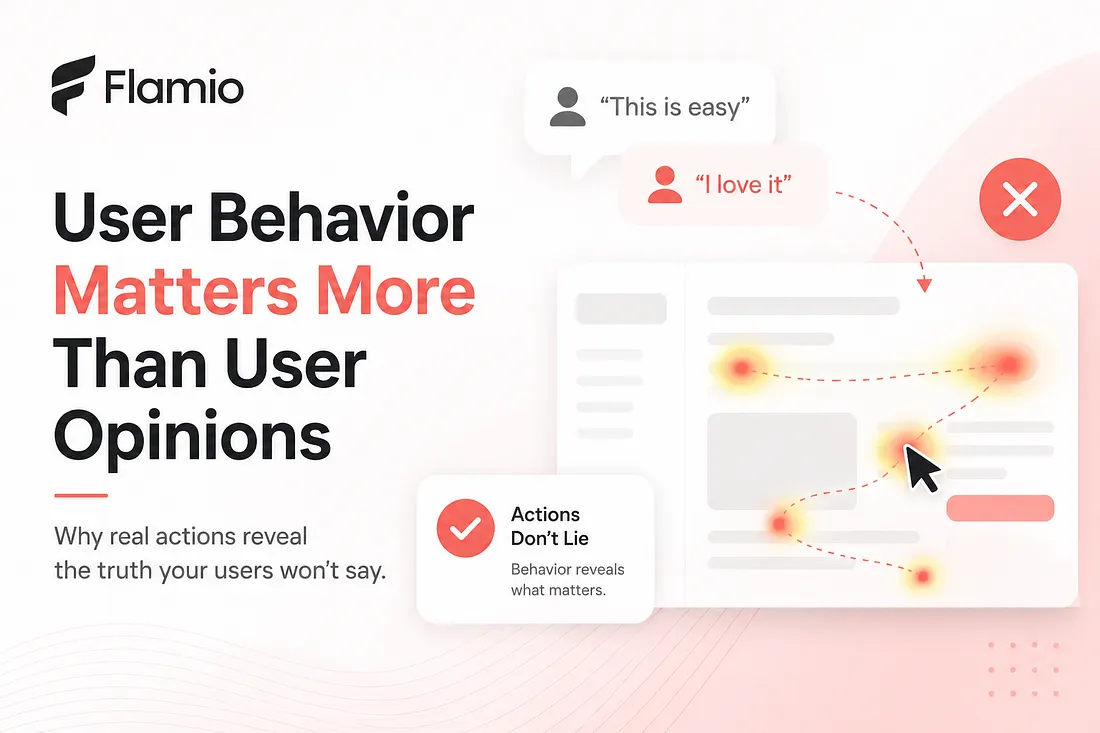
Product teams love asking users what they think. It feels responsible. It feels research-driven. It feels like the right way to avoid building the wrong thing. You run a survey, schedule a few interviews, ask people what they want, and collect a clean list of answers. Then the product launches, and users do something completely different. They said the onboarding was clear, but half of them never finish it. They said the pricing page made sense, but they hesitate before choosing a plan. They said a feature would be useful, but once it exists, nobody touches it. They said they understood the value, but their behaviour shows confusion, doubt, or friction. This is one of the hardest truths in UX research: user opinions are useful, but user behaviour is often more honest.
What users say is not always what users do
Most users are not trying to mislead you. They simply do not always know how they will behave until they are inside the real experience. In an interview, a user might describe themselves as logical, patient, and open-minded. In the product, they might rush, skip instructions, miss important buttons, abandon forms, or choose the fastest path even when it is not the best one. And this inconsistency is normal. People answer questions in a calm environment, but they use products in messy real-life contexts. They are distracted. They are tired. They are comparing alternatives. They are unsure whether they trust you. They may not fully understand what they need until the moment they are trying to complete a task. This is why user feedback should never be treated as the full truth. It is one layer of insight, not the final answer.
Writings can tell you what users believe
Polls and interviews can help you understand language, expectations, frustrations, and motivations. They are especially useful when you need to hear how people explain a problem in their own words. But they have limits. A poll can tell you that users think a feature sounds valuable. It cannot prove they will actually use it. An interview can tell you that users believe a page is easy to understand. It cannot show where they hesitate, scroll back, rage click, or abandon the flow. This matters because product validation is not about collecting positive reactions. It is about finding evidence that people can understand, use, and repeat the behaviour your product depends on. A user saying "I would use this" is not the same as a user actually using it. A user saying "this makes sense" is not the same as moving through the product without friction. A user saying "I like this idea" is not the same as coming back, converting, sharing, or paying.
Behaviour reveals friction before users can explain it
The strongest UX insights often appear in the moments users do not mention. A pause before clicking. A repeated scroll. A form field skipped twice. A button ignored. A user moving back and forth between two sections. A drop-off after a specific step. These are small behavioural signals, but they can reveal a lot. This is where behavioural design becomes practical. Instead of designing only around what users claim to prefer, teams begin designing around what users actually do. If users keep missing the same call to action, the problem is not their attention span. The interface is probably not guiding attention well enough. If users abandon the same step, the issue might not be motivation. It might be uncertainty, cognitive load, weak copy, poor hierarchy, or lack of trust. If users say a flow is simple but behave like it is confusing, the behaviour should win.
Good UX research connects words with actions
This does not mean interviews are useless. It means they should be paired with behavioural evidence. Because user feedback gives you context and user behaviour gives you proof. The best UX research combines both. You listen to what users say, then compare it with what they actually do. When the two match, you gain confidence. When they do not, you find the real research opportunity. For startup product development, this is especially important. Early teams do not have time to spend months debating assumptions. They need fast product validation. They need to know which parts of the product create clarity and which parts create friction. They need to make decisions based on real usage, not just polite feedback. A founder can hear ten users say the product is interesting and still have no idea whether the onboarding works. A designer can hear that a flow "looks clean" and still miss the fact that users do not understand the next step. A product manager can see good survey results and still lose users during activation. The problem is not lack of feedback. The problem is relying too much on feedback that is disconnected from behaviour.
Product teams need evidence, not reassurance
Opinions often make teams feel safe. But user behaviour makes teams face the facts. This is why modern UX research needs to move closer to real product usage. Instead of treating research as a one-time checkpoint, teams should build continuous loops between what they ship, how users respond, and what they improve next. And that loop changes the quality of product decisions. Instead of asking "Do users like this?" the team asks "Can users complete this?" Instead of "Does this sound useful?" the team asks "Do users come back to it?" And "Is this clear?" turns into "Where do users hesitate?" These questions are harder, but they lead to better products.
Why this matters for product validation
Product validation is often misunderstood as proving that people like an idea. Real validation is deeper than that. It means proving that users understand the value, can move through the experience, and behave in a way that supports the product growth. This is why user behaviour is so powerful. It turns vague opinions into observable patterns. You can validate whether users notice the main action. You can see whether they understand the onboarding. You can detect where they lose confidence. You can learn whether a feature creates momentum or confusion. And once you see those patterns, your roadmap becomes clearer. You stop designing for the imaginary user from an interview transcript. You start designing for the real user who is trying to complete a task, making decisions in seconds, and showing you through their actions what is working and what is not.
From user opinions to behavioral intelligence
Flamio is built around the idea that product teams do not need more raw opinions. They need a clearer understanding of real user behavior. Instead of positioning itself as another analytics dashboard, Flamio focuses on behavioral intelligence: helping teams understand hesitation, confusion, friction, cognitive overload, and patterns inside digital experiences. Its larger vision is to become an intelligence layer between interfaces and human behavior, where products can better understand what users are actually doing, not only what they say afterward. This is especially relevant for early-stage teams. Flamio go-to-market strategy focuses on helping startups, designers, founders, and product teams test real flows, analyze behavior recordings, detect friction, and turn those findings into actionable UX decisions. The goal is not just to collect feedback, but to move from internal assumptions to external product validation based on real usage. And that difference matters. A traditional feedback process might tell a team that users "liked" the product. Flamio is designed to help answer a more important question: what actually happened when users tried to use it?
Takeaway
Users may say many things, but their behavior tells the story product teams need to hear.
More Flamio notes
The End of Watching Session Replays by Hand
Session replay gave teams visibility, but the next product advantage is finding the moments that deserve attention without watching hours of playback.
AI insightsThe Best AI UX Research Will Start With Behaviour, Not Prompts
AI UX research becomes more useful when it starts from real user behavior, intended journeys, and friction patterns rather than isolated interface prompts.
Founder notesBefore You Hire a UX Researcher, Test One Flow
Early teams can learn a surprising amount by testing one critical flow before building a large research process or hiring a dedicated researcher.