

Why most SaaS onboarding flows fail
Most SaaS onboarding flows fail because they ask for too much before proving enough value, creating friction before activation can happen.
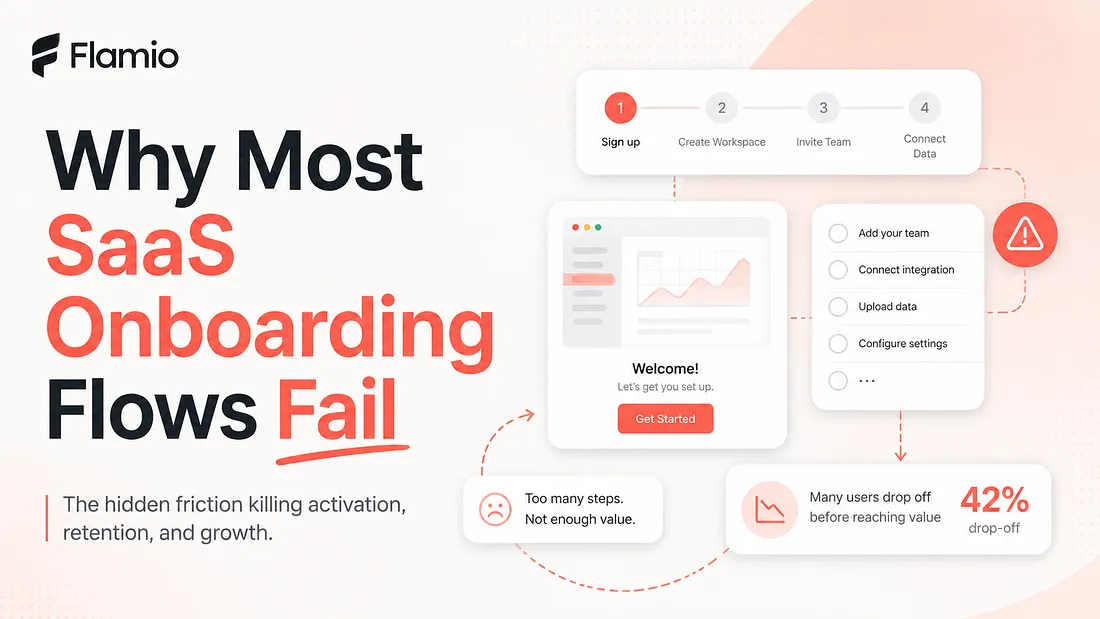
SaaS onboarding is often treated like a product introduction. A few screens, a welcome message, a checklist, maybe a tooltip tour, and the user is expected to "get it." But that is not really what onboarding is. Onboarding is the first test of whether a product can turn curiosity into value. It is where a user decides whether the promise that brought them in is real, whether the product feels understandable, and whether continuing is worth the effort. Most SaaS onboarding flows do not fail because the product idea is bad. They fail because the product asks for too much before proving enough. A user signs up with some expectation in mind. They want to solve a problem, finish a task, create something, understand something, or feel progress quickly. When the onboarding flow delays that moment, the product starts losing trust before the user has even experienced the core value.
Onboarding fails when value arrives too late
The biggest mistake in SaaS onboarding is assuming users are patient. They are not. New users do not arrive with unlimited attention. They arrive with a question: "Is this worth my time?" Every step in the onboarding flow either answers that question or makes it harder to answer. This is where many user onboarding flows break. They start by collecting information, explaining features, asking users to configure preferences, inviting teammates, choosing templates, completing profiles, connecting tools, or reading instructions. Some of these steps may be useful later. The problem is timing. If users are asked to invest effort before they feel value, the flow becomes a tax. They are doing work for a product that has not yet earned their confidence. Strong onboarding does not begin with everything the company wants to know. It begins with the smallest path to a meaningful result. In SaaS, activation is not the moment a user creates an account. It is the moment they understand why the product matters to them. That moment can be small, but it needs to be real. A dashboard that loads empty does not activate a user. A checklist that tells them to complete five setup steps does not activate them. A tour that explains every button does not activate them. Activation happens when the user feels progress.
Too many onboarding steps create invisible friction
Product teams often add onboarding steps for reasonable reasons. They want better personalization. They want cleaner data. They want users to understand the product properly. They want to reduce confusion later. They want users to set things up in the "right" way. Individually, each step may seem harmless. Together, they create drag. This is one of the hardest problems in product design because the flow can look perfectly logical from the inside. The team knows why each question exists. The team knows why setup matters. The team knows what happens after the user completes everything. The user does not. The user only sees effort. This is why unnecessary onboarding steps are so dangerous. They do not always look broken. They are not obvious bugs. They are not dramatic errors. They simply slow the user down enough that motivation starts leaking out of the experience. A form field that feels optional to the business may feel like a barrier to the user. A setup screen that feels helpful to the team may feel like homework to someone who just wants to try the product. A tooltip that feels educational may feel like noise when the user has not yet formed a mental model. The question should not be "Can we ask this now?" The better question is "Does the user need this to reach value?". If the answer is no, the step probably belongs later.
Weak feedback loops make users feel lost
A good onboarding flow constantly tells users that they are moving in the right direction. This does not mean filling the interface with progress bars and messages. It means giving clear feedback after every meaningful action. When users take a step, they need to understand what changed, why it mattered, and what they should do next. Without that feedback loop, onboarding becomes a sequence of actions with no emotional reward. This is where many SaaS products lose people quietly. The user clicks a button, but nothing meaningful appears to happen. They complete a setup step, but the product does not show why it mattered. They answer a question, but the next screen feels generic. They reach a dashboard, but it is unclear what success looks like. The product may be working technically, but the experience feels flat. Good user onboarding creates a rhythm: action, response, progress. The user does something, the product reacts, and the next step becomes clearer. This rhythm builds confidence. Bad onboarding creates uncertainty. The user keeps asking: "Did I do this right?" "What happens next?" "Why am I doing this?" "Is this product useful for me?". When those questions pile up, drop-off becomes predictable.
Product teams often measure the wrong thing
Many SaaS teams know where users drop off. Fewer know why. Product analytics can show that users leave on step three, skip an invite screen, abandon setup, or fail to reach activation. That information is useful, but it is incomplete. A drop-off point is not the same as a reason. Users may leave because the value is unclear. They may leave because the step feels too demanding. They may leave because the interface creates doubt. They may leave because the call to action is weak, the page is overloaded, or the product asks for a decision before the user has enough context. This is where UX research becomes important. Numbers can show the pattern, but behaviour explains the friction. The challenge is that traditional UX research often moves slower than the product team needs. By the time interviews are scheduled, tests are run, recordings are reviewed, and insights are summarized, the team may already be working on a new version of the flow. For SaaS onboarding, speed matters. Activation problems are not abstract. They directly affect growth, retention, conversion, and the quality of the user base. If a flow is leaking users today, the team cannot afford to understand it weeks later.
Better onboarding starts with less assumption
The best onboarding flows are rarely built from internal logic alone. They are shaped by watching how real users behave. Where do users hesitate? Which steps feel confusing? Which screens create unnecessary effort? Where does attention drop? Which actions look obvious to the team but unclear to new users? These questions are not always answered in planning meetings. They are answered through behaviour. A team may believe the welcome screen is clear. Users may still pause there. A team may believe the setup checklist is simple. Users may still avoid it. A team may believe the activation path is obvious. Users may still wander around the interface without reaching the core value. That gap between product intention and user behaviour is where onboarding fails. Product design improves when teams stop treating onboarding as a one-time flow and start treating it as a learning system. Every user session becomes evidence. Every hesitation becomes a clue. Every abandoned step becomes a signal. The goal is not to remove all complexity. Some products need setup. Some products need context. Some products need users to make choices. The goal is to make sure effort appears after value, not before it.
Finding onboarding friction before users disappear
Most SaaS onboarding problems come down to the same pattern: users are asked to move through a flow before the product has clearly proven its value. Extra steps slow them down, weak feedback makes them uncertain, and activation falls before the team fully understands why. Flamio helps product teams test onboarding flows quickly and find friction before activation starts dropping. Instead of waiting for a long research cycle, teams can use Flamio as a fast layer for understanding how users behave inside a flow, where they hesitate, what creates confusion, and which moments prevent users from reaching value. This fits the way Flamio is positioned in its own strategy: not as another basic analytics dashboard, but as an intelligence layer between digital interfaces and human behaviour. Its role is to help teams move from raw behaviour data toward clearer UX decisions. For SaaS teams, that matters because onboarding is not just a design problem. It is a growth problem, a product problem, and a trust problem. Flamio gives teams a faster way to test real onboarding paths, detect friction, and improve the moments that decide whether a new user becomes activated or disappears. Its go-to-market strategy also frames the product around turning user behaviour into actionable UX insights, especially for founders, designers, and product teams that need fast feedback without a full research process.
Takeaway
SaaS onboarding fails when products ask users for effort before delivering value. Better onboarding starts by finding and removing friction before activation drops.
More Flamio notes
The End of Watching Session Replays by Hand
Session replay gave teams visibility, but the next product advantage is finding the moments that deserve attention without watching hours of playback.
AI insightsThe Best AI UX Research Will Start With Behaviour, Not Prompts
AI UX research becomes more useful when it starts from real user behavior, intended journeys, and friction patterns rather than isolated interface prompts.
Founder notesBefore You Hire a UX Researcher, Test One Flow
Early teams can learn a surprising amount by testing one critical flow before building a large research process or hiring a dedicated researcher.