

Why Product Teams Ignore Research Until It Hurts Growth
Product teams usually do not ignore research because they do not care. They ignore it because the feedback loop feels slower than the build loop.
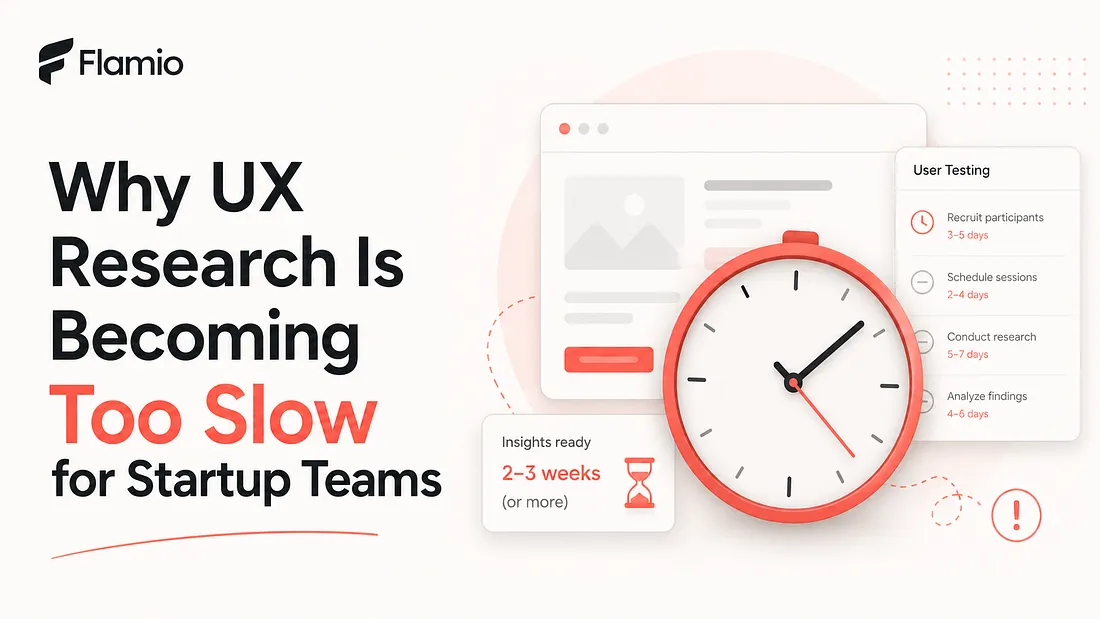
Most product teams do not ignore research because they do not care about users. They ignore it because nothing is visibly on fire yet. The onboarding completion rate looks acceptable. The activation graph is not great, but not catastrophic. Support tickets are annoying, but still manageable. The checkout flow has a few strange drop-offs, but the team has a roadmap, a launch deadline, and a backlog full of things that feel more urgent. So research gets pushed into the future. Then growth slows down, and suddenly everyone becomes interested in UX research. Not because the culture changed. Because the pain became measurable. The quiet problem with product friction is that it usually starts as a small behavioural signal before it becomes a business problem. A user hesitates on a pricing screen. Someone clicks the wrong thing three times. A tester scrolls up and down because the next step is unclear. A new user lands inside a dashboard and does nothing for ten seconds. Individually, these moments are easy to dismiss. Collectively, they become UX debt. And like technical debt, UX debt compounds quietly until the team can no longer ignore it.
Research is often treated like a post-mortem
In many startups, research enters the process after something breaks. Conversion drops. Activation stalls. A launch underperforms. Sales keeps hearing the same objection. Customer support starts collecting confused screenshots. A founder watches a session recording and realizes users are not experiencing the product the way the team imagined. At that point, product research becomes a rescue mission. The team wants answers quickly, but the research process now has to work under pressure. Instead of calmly understanding behaviour, the team is trying to explain a metric that has already moved in the wrong direction. This changes the quality of the work. When research happens early, it is exploratory. The team is open to learning. The question is: "Where might users struggle?" When research happens late, it becomes defensive. The question becomes: "Which part of the product is responsible for this number?" That sounds subtle, but it matters. Late research is more political. Everyone already has a theory. Design thinks the problem is messaging. Product thinks the problem is user intent. Growth thinks the problem is traffic quality. Engineering thinks the product works as specified. Leadership wants a fix before the next board update. The user, who should have been the centre of the conversation, becomes evidence in an internal argument.
Analytics show the symptom, not always the experience
Analytics are useful. Funnels, drop-off rates, event tracking, retention curves, and conversion data all matter. But analytics often tell you where something happened, not how it felt to the user. A funnel can show that users dropped between "create account" and "complete setup." It may not show that the setup screen used language the user did not understand. It may not show that the primary button looked disabled. It may not show that users were unsure whether they needed to invite a teammate before seeing value. This is where product teams get stuck. They have the number. They do not have the experience. So they guess. A team changes the button text. Then the layout. Then the onboarding checklist. Then the emails. Sometimes things improve, sometimes they do not. But the process becomes trial and error disguised as iteration. This is one of the most common startup mistakes: confusing movement with learning. Shipping more experiments does not automatically mean the team understands the user better. Sometimes it just means the team is producing more variations of the same assumption. Good UX researchers are valuable because they slow the team down in the right place. Not by blocking shipping, but by helping the team ask: what is actually happening in the user's mind during this flow? Where do they hesitate? What do they expect next? Which part of the interface creates doubt? Where does the product's intended journey split from the user's real behaviour? That gap is where conversion friction lives.
The cost of friction is usually paid later
Product teams often delay research because the cost feels immediate. Recruiting users takes time. Reviewing recordings takes time. Running tests takes time. Turning observations into decisions takes time. For a small team, that can feel expensive. But skipping research does not remove the cost. It moves it. You pay later through lower activation. You pay through more support tickets. You pay through unclear roadmap debates. You pay through redesigns that could have been avoided. You pay through feature adoption that never reaches its potential because users never understood the path to value. UX debt is rarely dramatic at first. It looks like "just a small issue." A signup form asks for too much too soon. A dashboard shows everything before the user understands anything. A checkout page hides the information needed to feel confident. A search flow returns results, but not in the way users expect. A permissions step appears before trust has been built. None of these moments necessarily destroy the product. But they create drag. And growth is highly sensitive to drag. The more friction a product carries, the more marketing, sales, onboarding, and support have to compensate for it. This is why research is not only a design activity. It is a growth activity.
Teams do not need more raw behaviour
One reason research gets postponed is that existing workflows often feel too heavy for the speed of modern product teams. A founder may not have a dedicated research team. A designer may not have time to review hours of session recordings. A PM may already have dashboards, but still lack qualitative explanation. A UX researcher may be buried in synthesis work instead of spending time on higher-level insight. The issue is not that teams lack data. Most teams have too much raw data and not enough interpretation. Recordings, heatmaps, clicks, scroll depth, event logs, feedback forms, support tickets, sales notes, survey responses. The material exists. The bottleneck is turning it into a decision. That is why AI UX research is becoming interesting, not because it replaces human judgment, but because it can reduce the distance between behaviour and insight. The real opportunity is not "AI writes a research report." The opportunity is that product teams can build a faster habit of looking at real user behaviour before the cost of friction shows up in growth metrics. Research becomes less like a quarterly project and more like a product reflex.
Where Flamio fits
This is the problem Flamio is trying to address: making UX testing lightweight enough to use before friction becomes a growth problem. The important part is not just automation. Plenty of tools automate data collection. The more interesting question is whether a tool helps a team understand what to do next. Flamio's positioning is built around that distinction. It is not framed as another analytics dashboard, UX testing tool, or session replay platform. It is an intelligence layer between digital interfaces and human behaviour, focused on helping teams understand user intent, hesitation, confusion, friction, cognitive overload, and behavioural patterns. That framing matters because the core problem is not "we need more recordings." It is "we need to understand why the user struggled inside this flow." Flamio Vision approaches this through the Happy Path, the intended user journey for a task such as onboarding, checkout, search, or another product flow. Instead of only recording what users did, Flamio compares real behaviour against the journey the team expected users to follow. That creates a useful shift in the research conversation. The team is no longer just asking, "What did people click?" They can ask, "Where did real behaviour diverge from the intended path, and does that divergence signal valid exploration or actual friction?" Flamio uses behavioural signals like clicks, scrolls, hesitations, dead clicks, and navigation changes, while also applying a semantic layer that understands task context. The output is designed to be structured: friction points, severity, affected users, why it matters, and recommendations. For a founder, that means testing one important flow without turning research into a large operational project. For a designer, it means getting behavioural evidence for recommendations instead of relying only on opinion. For a PM, it means connecting product growth issues with observable user struggle. For UX researchers, it can reduce the manual burden of reviewing behaviour and help focus human attention on interpretation, prioritization, and deeper learning. The best version of this is not a product team outsourcing empathy to AI. That would be the wrong lesson. The better version is a team using AI to make research frequent enough that empathy is not reserved for crisis moments.
The strategic shift
The teams that build better products are not always the ones with the largest research departments. Often, they are the ones with the shortest distance between user behaviour and product decisions. They notice friction early. They treat hesitation as signal. They watch real users before the dashboard turns red. They do not wait until conversion drops to ask whether the interface makes sense. This is the mindset shift product teams need. Research should not be the thing you do after growth slows down. It should be one of the reasons growth has fewer hidden blockers in the first place. By the time friction is visible in the metrics, users have already been paying the price. The product team is just finally seeing the invoice.
Takeaway
Research should not be the thing product teams do after growth slows down. It should be one of the reasons growth has fewer hidden blockers in the first place.
More Flamio notes
The End of Watching Session Replays by Hand
Session replay gave teams visibility, but the next product advantage is finding the moments that deserve attention without watching hours of playback.
AI insightsThe Best AI UX Research Will Start With Behaviour, Not Prompts
AI UX research becomes more useful when it starts from real user behavior, intended journeys, and friction patterns rather than isolated interface prompts.
Founder notesBefore You Hire a UX Researcher, Test One Flow
Early teams can learn a surprising amount by testing one critical flow before building a large research process or hiring a dedicated researcher.