

Why UX Research is becoming too slow for startup teams
Traditional UX research can be too slow for startup teams that need fast answers about onboarding, signup, conversion, and product friction.
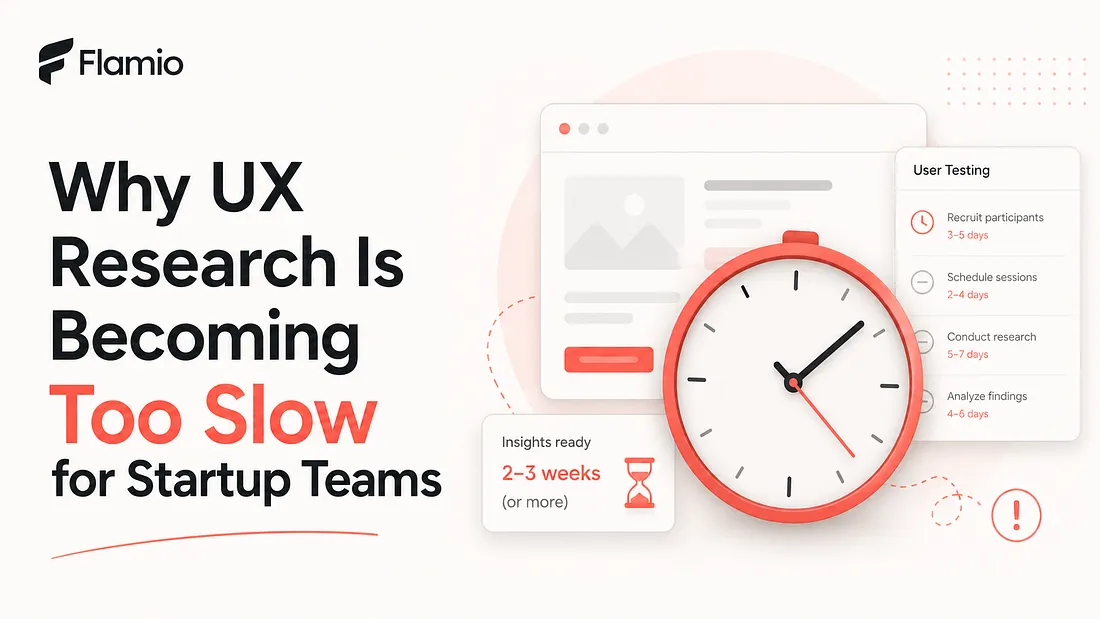
For a long time, UX research was treated as something that happened in structured cycles. A team would define a research question, recruit participants, prepare a testing plan, run sessions, collect notes, analyse recordings, summarize insights, and then share findings with product teams. That process can be valuable. It gives teams depth, context, and a more human understanding of how people experience a product. But for many startups, the problem is no longer whether UX research is useful. The problem is whether the team can afford to wait long enough for the answer. Startup teams move in short loops. They ship landing pages, onboarding flows, signup screens, pricing pages, dashboards, and checkout experiences under constant pressure. Every week matters. Sometimes every day matters. If users are dropping off during signup or failing to complete onboarding, waiting two or three weeks to understand why can be too slow. This is why UX research is starting to feel out of sync with how startup UX actually works.
The startup problem is speed
Most startups do not have the luxury of long research cycles. They often have small product teams, limited budgets, and a constant need to validate decisions quickly. A founder might notice that signup conversion is low. A product manager might see that users start onboarding but never finish. A designer might suspect that a form is too confusing, but there is not enough evidence to prove it. In a larger company, this might turn into a formal usability testing project. In a startup, the team usually needs a useful answer before the next sprint planning meeting. The core question is simple: why are users not moving forward? Analytics can show where the drop-off happens. It can show that 64 percent of users leave after step two, or that fewer people complete account setup after a new design change. But those numbers do not explain what users were thinking, where they hesitated, what confused them, or why the flow felt harder than expected. That gap is where traditional UX research becomes important. It gives product teams the qualitative layer behind the metrics. But if the process takes too long, the insight may arrive after the team has already moved on.
User testing is useful, but heavy
User testing remains one of the strongest ways to understand real product behaviour. Watching someone interact with a signup flow or onboarding sequence can reveal things that dashboards never show. People pause before unclear buttons. They reread confusing copy. They miss important UI elements. They click something that looks interactive but is not. They abandon a form because the next step feels too demanding. These moments are small, but they matter. In startup UX, small frictions often create big conversion problems. The challenge is that user testing can become operationally heavy. Someone has to recruit testers, schedule sessions, prepare tasks, moderate calls, take notes, review recordings, identify patterns, and translate findings into product decisions. For a startup team already trying to build, sell, support users, and raise money, that is a lot of overhead. This does not mean usability testing is outdated. It means the traditional way of doing it often does not match the pace of early-stage product work. Startups need user testing that is lighter, faster, and closer to the decisions being made every week.
Product teams need insight before the problem gets expensive
A weak onboarding flow is not just a design problem. It can affect activation, retention, revenue, and investor confidence. If users do not finish signup, they never reach the product value. If they do not understand onboarding, they may assume the product is not useful. If they hesitate at the wrong moment, the team may lose a customer before the product gets a fair chance. This is why slow UX research can become expensive. The longer a team waits to understand user behaviour, the more decisions are made on assumptions. A designer may simplify the wrong screen. A founder may rewrite messaging that was not the real issue. A product manager may remove a step that was not causing the friction. The team moves quickly, but without the right insight, speed can turn into noise. For startups, the goal is not to run research for the sake of research. The goal is to shorten the learning loop between user behaviour and product improvement. That means product teams need a way to answer practical questions quickly. Why did users stop here? What confused them? Which part of the flow created friction? What should we improve next?
The real bottleneck is not data collection
Most product teams already have more data than they can use. They may have analytics events, session recordings, user testing notes, support messages, and feedback from sales calls. The issue is not always a lack of information. The issue is that turning behaviour into insight takes time. Someone still has to watch the recordings. Someone still has to notice the hesitation. Someone still has to connect the pattern across multiple sessions. Someone still has to translate what happened into a clear product recommendation. That is where the bottleneck appears. Product analytics can tell a team what happened. UX research can explain why it happened. But the slowest part is often the interpretation layer between the two. This is especially painful for small product teams, where nobody has hours to manually review user behaviour after every release. In practice, many startup teams skip the analysis because it is too time-consuming. They collect evidence, but they do not deeply use it. They know user behaviour matters, but they cannot afford to inspect every session carefully. This creates a strange situation: teams have access to user behaviour, but not enough time to understand it.
Fast research does not mean shallow research
There is sometimes a fear that faster UX research means lower-quality UX research. That is not necessarily true. Fast research does not mean rushing to random conclusions. It means reducing the delay between observing behaviour and identifying useful patterns. It means focusing on the flows that matter most, such as signup, onboarding, activation, checkout, or feature adoption. It means using smaller tests more often instead of waiting for large research cycles. For startup teams, this approach is often more realistic. A team does not always need a perfect research report. Sometimes it needs a clear signal that users do not understand the first onboarding step. Sometimes it needs proof that the call to action is being missed. Sometimes it needs to know that users are hesitating because the form asks for too much too early. These insights do not need to take weeks. They need to be accurate enough to guide the next product decision. The future of UX research for startups will likely be more continuous, more behaviour-based, and more integrated into product workflows. Instead of treating research as a separate phase, teams will expect user insights to appear closer to the moment of product iteration.
Why this shift matters for product teams
Product teams are under pressure to make decisions quickly, but good decisions still require evidence. That is the tension. Without UX research, teams risk building from assumptions. With traditional UX research, they may wait too long. The new expectation is somewhere in between: fast enough for startup execution, but deep enough to explain real user behaviour. This is especially important for early-stage teams that do not have full research departments. A founder, product designer, or product manager may be responsible for understanding users while also shipping features. They need tools and workflows that help them detect friction without turning every question into a major research project. The best startup UX teams are not the ones that run the most research. They are the ones that learn from users the fastest and apply that learning before the next mistake compounds.
How Flamio helps startups learn faster
The problem is not that startups do not care about UX research. The problem is that traditional research workflows are often too slow for the moments when startups need answers most. When users fail to complete onboarding, abandon signup, or hesitate inside a key flow, product teams need insight quickly. They need to understand not only what happened, but why the experience broke. Flamio is built for that gap. It acts as a quick, behaviour-based layer for short user tests, helping teams analyse user behaviour and turn it into actionable UX insights. Instead of asking small teams to manually review every recording or wait through a long usability testing process, Flamio helps detect friction, understand hesitation, and translate behaviour into clearer product decisions. Its positioning is not just about showing what users did, but explaining what went wrong, why it matters, and what the team should improve next. For startup teams, that speed matters. Flamio gives founders, designers, and product teams a faster way to test real flows, understand onboarding friction, and learn from user behaviour before weeks are lost. In a world where interfaces need to understand humans faster, Flamio becomes the layer between raw behaviour and practical UX insight.
Takeaway
UX research still matters for startups, but it has to become faster, lighter, and closer to the product decisions teams make every week.
More Flamio notes
The End of Watching Session Replays by Hand
Session replay gave teams visibility, but the next product advantage is finding the moments that deserve attention without watching hours of playback.
AI insightsThe Best AI UX Research Will Start With Behaviour, Not Prompts
AI UX research becomes more useful when it starts from real user behavior, intended journeys, and friction patterns rather than isolated interface prompts.
Founder notesBefore You Hire a UX Researcher, Test One Flow
Early teams can learn a surprising amount by testing one critical flow before building a large research process or hiring a dedicated researcher.